
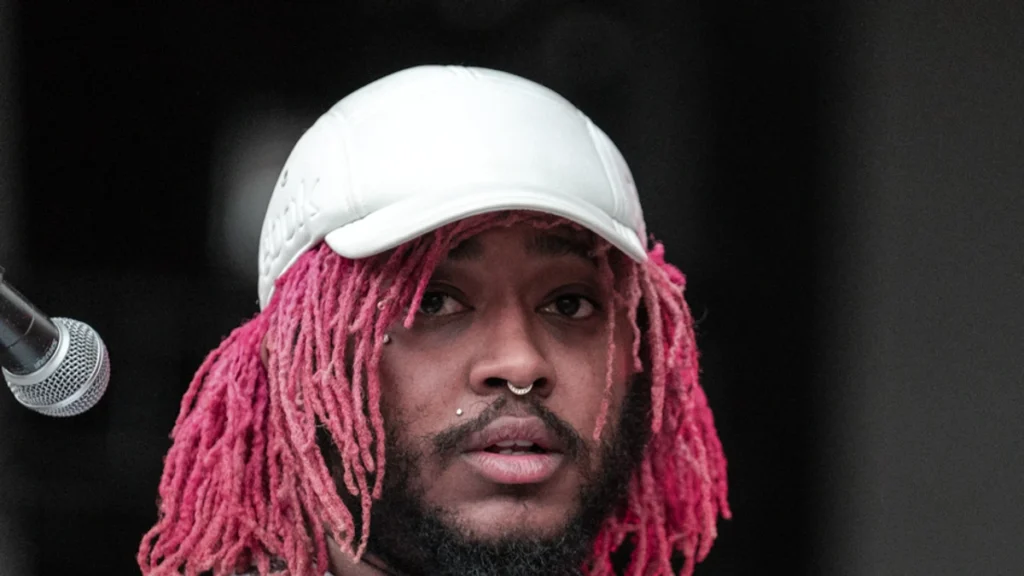
In April 2023, Thundercat put out a single called “No More Lies”. The album it belongs to arrived in April 2026.
Three years is not a delay in the usual sense — nothing was announced and then postponed. The song simply existed on its own for that long before Distracted gave it a home.
Five Singles Across Three Years
Most listeners will never notice, which is part of the point. A streaming tracklist carries no release dates, so a song three years old and one finished last winter arrive at the ear identically.
The rollout, laid out end to end, is unusual enough to be worth listing. “No More Lies” came in April 2023. “I Wish I Didn’t Waste Your Time” followed in September 2025, two and a half years later. Then three more in quick succession: “I Did This to Myself” in January 2026, “She Knows Too Much” in February, “ThunderWave” in March.
So the campaign was really two campaigns. One song released into silence, and then a conventional four-month run of singles immediately before the album.
That shape usually means a record changed underneath its own schedule. A song finished early enough to release on its own, an album that took another three years to resolve around it, and a decision at the end to treat the old single as part of the finished thing rather than orphaning it.
“No More Lies” was itself a collaboration, made with Tame Impala, which is part of why it worked as a standalone. A single credited to two acts has a life of its own and does not obviously belong to anybody’s forthcoming record — it can sit in the world for years without raising the question of what it is from.
Six Years Since the Last One
The gap either side is the real context. Distracted is his fifth studio album and the first since It Is What It Is in 2020 — a record that won the Grammy for Best Progressive R&B Album.
Following an award-winning album is a specific kind of difficulty, and six years is a long time to sit with it. The three-year-old single starts to look less like a scheduling quirk and more like evidence of how long the record took to become itself.
It runs forty-six minutes and forty-two seconds, recorded at No Expectations in Hollywood, and came out through Brainfeeder — the label he has been associated with throughout, which is its own kind of continuity across a long gap.
A Producer Credit List That Explains the Wait
Working with Kurstin at all is the surprise. He is the producer labels reach for when a record needs to be finished and legible, which is not the reputation Thundercat’s catalogue has cultivated. Pairing him with Flying Lotus on the same album is close to a statement of intent about wanting both qualities at once.
The album was executive produced by Thundercat himself with Greg Kurstin, and carries further credits from Flying Lotus, Kenny Beats and the Lemon Twigs.
That is a genuinely odd combination, and a revealing one. Kurstin is a mainstream pop architect; Flying Lotus is the experimental producer Thundercat’s career has been intertwined with for over a decade; Kenny Beats comes from rap; the Lemon Twigs are a guitar band working in 1970s pop pastiche.
Four sensibilities that far apart do not converge quickly. A record assembled from them is likelier to take three years than one built with a single collaborator, and the singles timeline is consistent with a project that kept opening up rather than closing down.
It is also worth noting how little of this was signalled. There was no long announcement cycle, no title revealed a year out, no delay to apologise for. The album simply resolved when it resolved, and the singles marked the point at which it had.
The Bassist Who Came From a Hardcore Band
Stephen Lee Bruner’s route to this is stranger than his catalogue suggests. He first came to prominence as a member of the heavy metal band Suicidal Tendencies before turning to funk, soul, progressive R&B, psychedelia and jazz fusion.
The bass is the constant. Rolling Stone has ranked him among the greatest bass players of all time, which is a rare thing to say about a musician who also fronts his own records and sings on them.
His outside work is where most listeners met him: the long partnership with Flying Lotus, and his contributions to Kendrick Lamar’s To Pimp a Butterfly, which won him a Grammy in 2016 for Best Rap/Sung Performance on “These Walls”.
The Suicidal Tendencies years are not a footnote either. Playing bass in a hardcore band demands speed, stamina and precision under volume, and those are transferable to the kind of dense, fast, melodic playing his solo records are built on. The genre changed; the technical demand did not.
What the Reviews Made of It
The reception was strong. Distracted holds a Metacritic score of 81 and 7.6 at Any Decent Music, with four out of five from AllMusic.
An 81 is a good outcome for a record made this way. Albums assembled slowly from disparate collaborators often arrive incoherent, and the scores suggest this one resolved into something rather than remaining a collection of sessions.
It also means the three-year-old single was not a liability. A song that has been available since 2023 sitting inside a 2026 album could easily have dated it; instead it appears to have been absorbed.
That combination — a Grammy for someone else’s album, then a Grammy for his own — is why the six-year gap carries weight. He is not an artist waiting to be discovered on the fifth record; the audience was already there and had been waiting the whole time.
Why the Slow Route Suits Him
Thundercat’s music has never depended on being timely. It is built on playing — on bass lines complex enough that the interest survives repeat listening, and on a register that moves between comedy and melancholy without settling.
The singing matters here too. He is a bassist first by reputation, but the vocals carry most of the emotional weight on his solo records, sitting high and slightly fragile over playing that is anything but. That contrast is the signature, and it is not something a collaborator can supply.
Music like that ages slowly, which is exactly why a single can sit unattached for three years and still fit. A record built on a production trend could not survive the same treatment.
Our piece on the funk pocket explained covers the rhythmic tradition his playing works inside.
There is a wider point in it about release schedules. The industry standard is to hold everything until a coordinated launch, on the theory that scattered releases waste momentum. This record did the opposite by accident or by choice, and the reviews suggest nothing was lost — which is worth noticing at a moment when most campaigns are built on the opposite assumption.
Six years, five singles, four producers and one album that took its time. On the evidence of the reviews, it needed all of it.
Whether the next one takes another six years is anybody’s guess. On this evidence, the wait is not the problem it is usually assumed to be.
Distracted is out now on Brainfeeder.
About The Author





More Stories
Kirk Franklin Takes the Record Behind Dey Know to Church
The Line From Port Harcourt to Holy Ghost, Where D.A BIZ Sets a Prayer to Afrobeat
Why Eyes Closed by STARNAMEDSUN Still Matters to the Lineage of Dark R&B