
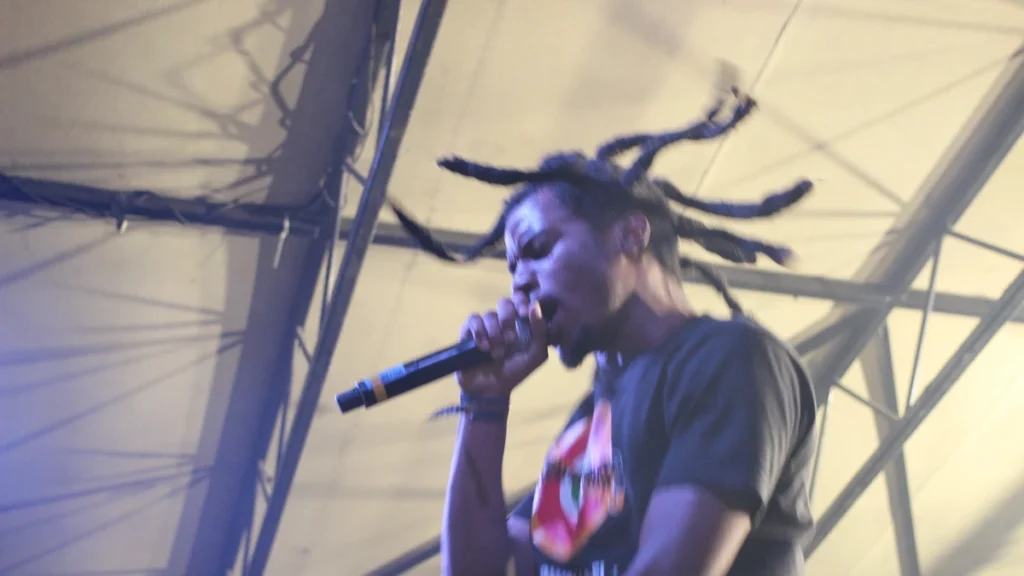
The day after releasing it, Denzel Curry found himself explaining what kind of record he had made. Nine tracks, twenty-four minutes, and a section of the audience had decided that made it an EP.
His answer was short and slightly exasperated: it is not an EP, it is an album, and if the objection is the track count, then remember that Daytona was an album with seven.
The Length Argument Is Not Really About Length
II, styled in lowercase and also carried as Unlocked II, came out on 21 August 2026 through PH and Loma Vista Recordings. It runs twenty-four minutes and seven seconds.
The distinction he is defending matters more than it used to. Streaming pays by the play, and an artist wanting revenue is pushed toward more tracks, not fewer. A short, tight record is now the choice that costs money, which is exactly why the label attached to it carries weight — an EP reads as a stopgap, an album as a statement.
The Daytona comparison is well chosen. That record is brief by any standard and nobody files it as a minor work, which makes the point that duration was never the criterion. Intent and completeness were.
The Sessions Nearly Came Apart
The making of it was not smooth. Curry and Kenneth Blume — the producer who worked as Kenny Beats on their earlier record and now uses his own name — fell into personal disputes during the project.
What resolved it was subtraction. They simplified the production down to a Roland SP-404 and a cheap microphone, and made the record on that.
Anyone who has watched a collaboration stall will recognise the move. Arguments in a studio are rarely about the music itself; they are about scope, and about the accumulating weight of options. Removing almost every option removes almost every argument, and an SP-404 with one poor mic is about as few options as a rapper and a producer can have.
It also suits them. Blume’s reputation was built on speed and instinct, and Curry is at his sharpest when he is not being carefully framed.
A Sequel to a Record Nobody Saw Coming
The pair’s first collaboration, Unlocked, appeared in 2020 with no prior announcement at all. It became one of the more admired short projects of its year, and Unlocked 1.5 followed in 2021.
They found each other through YouTube rather than through an industry introduction. While Curry was touring his 2018 album Ta13oo, people around him kept pointing him toward Freddie Gibbs’ appearance on The Cave, the bi-weekly freestyle series Blume hosted and uploaded himself. The producer’s reputation at that point was built on filming rappers working quickly in a room, which is more or less what the two of them went on to do.
Unlocked, stylised in capitals, was received warmly by critics for exactly that quality, and reached number 100 on the Billboard 200 — a modest chart figure for a record whose influence ran well past it.
Curry then went elsewhere and got larger, releasing Melt My Eyez See Your Future in 2022 and, this year, Strictly 4 the Scythe. Blume has kept working too; his own Fathers arrived earlier in 2026.
So this is not a reunion of two people with nothing else happening. Both had somewhere else to be, which is usually why sequels of this kind do not get made.
The tease was in keeping with the tone. On 11 August the two posted a video of themselves walking through mountains, talking about their legacy and their impact — a straight-faced setup for a record that arrived ten days later.
The Producer Dropped the Producer Name
One quiet change sits on the cover. The credits read Kenneth Blume, not Kenny Beats — his own name in place of the alias he built the reputation under.
Producer names are usually protected assets, because they carry the catalogue and the search results with them. Retiring one at the point of a sequel to your best-known record is a deliberate choice, and it reframes what the album is: not a return to the Kenny Beats formula but a record by the person who made it.
The joint billing supports that reading. Unlocked was a Denzel Curry release with Kenny Beats attached; II is credited to two people.
What Is Actually on It
Blume produced everything. The guests are JPEGMafia, who appears on “Evil Grin”, Westside Gunn, and the singer Yebba.
The tracks are short to the point of being abrupt: “Gone Fishing” at 2:04, “Evil Grin” at 2:22, “Candlelight” 2:46, “Product” 2:45, “UPS” 2:22. Nothing lingers, and with a twenty-four-minute running time nothing can.
“Difference”, the lead single released on 12 August, was described by Stereogum’s Tom Breihan as a cluttered, energetic boom-bap track with Curry in fired-up but technically precise form, carrying a hook from Yebba. “Gone Fishing” followed on release day as the second single.
The back half holds the longest pieces and the guests. “Cold Night in Hell” runs 3:27, and “Crown”, at 3:04, brings in Westside Gunn. “Difference” closes the record at 2:48, which means the lead single is also the last thing on it — an unusual placement, and one that only works when a record is short enough for the ending to still feel like an arrival.
Boom bap is the operative word. An SP-404 and a cheap mic will not produce a polished contemporary rap record, and the pair appear to have decided early that they were not attempting one.
The Reviews Split Wide Open
Reception divided more than the pair’s earlier work did. Clash gave it 8 out of 10 and Anthony Fantano landed on the same number, describing it as a light eight. Pitchfork came in at 5.9.
That is a substantial gap, and it tends to follow records built on constraint. A stripped-back album asks the listener to value what is absent, and critics differ sharply on whether absence reads as discipline or as an unfinished idea.
The EP question sits underneath that disagreement too. A reviewer who hears twenty-four minutes as a full statement grades it one way; a reviewer who hears a sketch grades it another. Our piece on why hip-hop never homogenised covers the broader habit of the genre refusing a single agreed standard.
The Tour Will Settle It Better Than the Discourse
Curry takes the record out from 26 September, opening in Newport, Kentucky and closing on 13 November in Springfield, Missouri.
Twenty-four minutes is not a set, so the material will sit inside a longer show alongside a catalogue that now spans several albums. How it holds up in that company is a more useful test than the track count, and a considerably more interesting one than whether the word on the sleeve should read album or EP.
It is also his second release of the year, after Strictly 4 the Scythe. Two records in a single year from an artist who spent the previous stretch making longer, more elaborate albums suggests the constraint was not a one-off experiment so much as a working preference he has decided to trust.
Curry has, in any case, already given his ruling.
II is out now on PH and Loma Vista Recordings.
About The Author




More Stories
Kirk Franklin Takes the Record Behind Dey Know to Church
The Line From Port Harcourt to Holy Ghost, Where D.A BIZ Sets a Prayer to Afrobeat
Why Eyes Closed by STARNAMEDSUN Still Matters to the Lineage of Dark R&B