
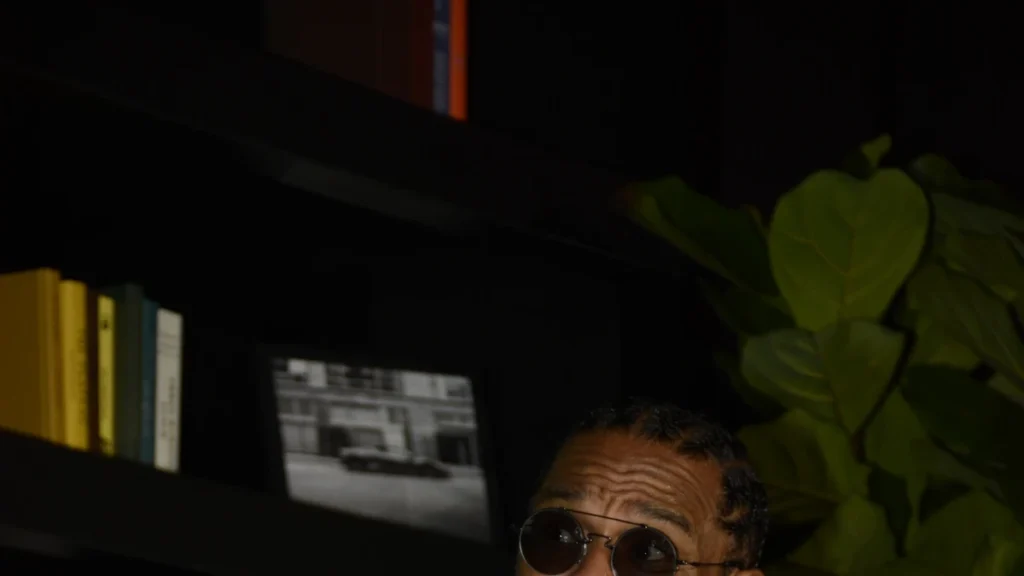
Maxwell at the Essence Festival of Culture.
Maxwell at the Essence Festival of Culture.
The third part of Maxwell’s trilogy has been coming for years. Asked directly when it would arrive, he gave an answer that had nothing to do with studios, labels or writing.
“I’m going to be 100 with you, because sometimes people need to know the humanity you represent, and not just the music and not just the presentation: I had been dealing with a nerve condition,” he told Billboard.
Onstage and in Agony
He kept working through it. He toured, he recorded the single “Simply Beautiful”, and he played NPR’s Tiny Desk, a performance that has since passed 5.9 million views on YouTube. None of it made the condition easier to manage.
“I couldn’t really seem to get ahead of it,” he said. “I’d be on stage and in absolute agony — but I knew I had to do the shows, because there was the incentive to not cancel given the people and businesses working with me behind the scenes.”
That last clause is the least romantic and most honest part of the whole account. A touring artist in pain is also an employer, and the crew, the band and the venues all have money committed. Cancelling is not a private decision.
Anyone who watched that Tiny Desk was watching a man in physical difficulty and would have had no way of knowing it. Singing is a bodily act performed in public, and the performer’s job description includes concealing whatever the body is doing that the audience did not pay for.
A Trilogy Held Open for a Decade
The sequence began in 2009 with the Grammy-winning BLACKsummers’night, continued in 2016 with blackSUMMERS’night, and is meant to close with blacksummers’NIGHT. Ten years have passed since the middle record.
Maxwell is clear that the delay was a refusal rather than a failure. “I also needed to be sure that I could get behind promoting and celebrating it in front of people. So until I was sure, I didn’t want to release the album just because of a financial or deadline reason.”
His reasoning goes further than logistics. “People don’t realize that when you’re making music, it’s about a feeling. If you’re not feeling well, the music isn’t going to feel well either. I love the craft way too much to make it a 9-to-5, a duty and not a pleasure.”
He also says the material exists: “I know the music has been written from a place of great vibes and intention.” The record is not missing. It is being withheld until its author can do the second half of the job, which is stand in front of it.
The three-album structure is part of the problem. A trilogy announced in advance turns every year of silence into a countdown somebody else is running, and the artist ends up owing an answer to a schedule he set himself in 2009.
What an Ensemble Can Be
Rather than wait quietly, he built a live project around the gap. The Silent Serenade Ensemble ran as a limited four-night residency — three nights at the MGM National Harbor outside Washington, D.C., and one at the Kings Theatre in Brooklyn, the borough he comes from.
The concept is deliberately unfixed. “The ensemble can be anything we want,” he said. “It can be a choir that sings in doo-wop, it can be all strings including harps, it can be reeds… It can be all kinds of versions and combinations of instruments that you’ve never seen put together before to present and perform songs that people know already and deeper cuts.”
It is not his first reworking of his own catalogue. He played sold-out dates in 2023 accompanied by symphony orchestras in San Francisco, Las Vegas and Washington, D.C.
Yola opened the Silent Serenade nights, a booking he explains in terms of range rather than genre. “I saw her during the pandemic on either Jimmy Kimmel or Stephen Colbert, and she was singing a country rock record. I just love what she represents: her Blackness, her broadness, her scope, her limitless sense of things.”
The setlists reach for things he has left alone. He mentioned B-sides and the possibility of both parts of “‘Til the Cops Come Knockin'”, which he says he has not performed since his earliest days.
Slow Songs, Late at Night
Maxwell arrived as a pioneer of the 1990s neo-soul movement, and the run of gold and platinum records behind him — “Pretty Wings”, “Lifetime”, “Simply Beautiful” — belongs to a specific listening habit rather than a chart.
These are songs built for the small hours: slow tempos, held falsetto, arrangements with space in them. That is the territory the quiet storm format was invented to serve, and it is where his catalogue has always lived, whatever the industry label of the decade happened to be.
Which is why an ensemble of harps, reeds and a doo-wop choir is not a novelty for him. Reinterpreting a slow song with strings is not a stunt when the song was already about restraint; it is simply another way of holding the same note.
The concert format follows from it. Maxwell plays seated theatres — the Kings Theatre, a casino showroom — rather than arenas, and that choice matches the music. A ballad sung at the top of a room’s volume stops being a ballad.
Third Time on the Water
February brings the third annual Urban Hang Suite Cruise. Rated R&B reports the five-night voyage sailing from Miami on the Norwegian Joy between 7 and 12 February, calling at Great Stirrup Cay in the Bahamas and Amber Cove in Puerto Plata.
The bill is substantial: The Isley Brothers, Kem, Lucky Daye, Kelly Price, Tweet, PJ Morton, Elle Varner and the trio Moonchild, with the comedian Joyelle Nichole Johnson. Maxwell himself gives two performances.
SoulBounce notes the ship is an upgrade: after two sold-out years on the Norwegian Pearl, the cruise has moved to a larger vessel with more cabins, more restaurants and a go-kart track. The previous edition called at the Cayman Islands and Jamaica, with Anthony Hamilton, Marsha Ambrosius, Lalah Hathaway, Avery*Sunshine, Terrace Martin, Tye Tribbett, Third World, Yellowman and Sharon Marley aboard.
Maxwell declines credit for the line-up. “I can’t take full credit for the people who curate it; they don’t tell me until it’s done because I have anxiety,” he said, before describing what he thinks it achieves: “a putting-people-in-front-of-people type of moment again.”
A sold-out cruise is also a commercial fact worth noting. An artist who has not released an album in a decade filling a ship twice over is evidence that the catalogue, not the release schedule, is what the audience is buying.
Not Done Yet
Underneath the residencies and the boat is an argument he keeps returning to. “I want to present the evolution of Black music as it’s represented through all the different genres that we’ve actually created in America: blues, gospel, R&B, soul, rock ‘n’ roll and jazz.”
He makes the claim expansively: “Reggaetón is a form of hip-hop. Rock ‘n roll was invented by Little Richard. And country music is Black music too. I want to represent, show, celebrate and solidify who we are.”
His stated worry is about attention rather than credit. “I don’t think people really listen to music in the way that they used to,” he said, describing an era in which “it’s become all about texting and emojis, but we aren’t really connecting with each other.”
It is the same instinct driving other veterans of this music — George Clinton building a working replacement for a spacecraft that is now in the Smithsonian — a refusal to let the archive be the last word while the performer is still standing.
Maxwell’s closing line to Billboard withholds as much as it promises, which is consistent with everything else. “It’s actually coming true, but I can’t tell you what it is yet… other than I’m not done yet; you ain’t seen the last of me.”
About The Author



More Stories
Kirk Franklin Takes the Record Behind Dey Know to Church
The Line From Port Harcourt to Holy Ghost, Where D.A BIZ Sets a Prayer to Afrobeat
Why Eyes Closed by STARNAMEDSUN Still Matters to the Lineage of Dark R&B