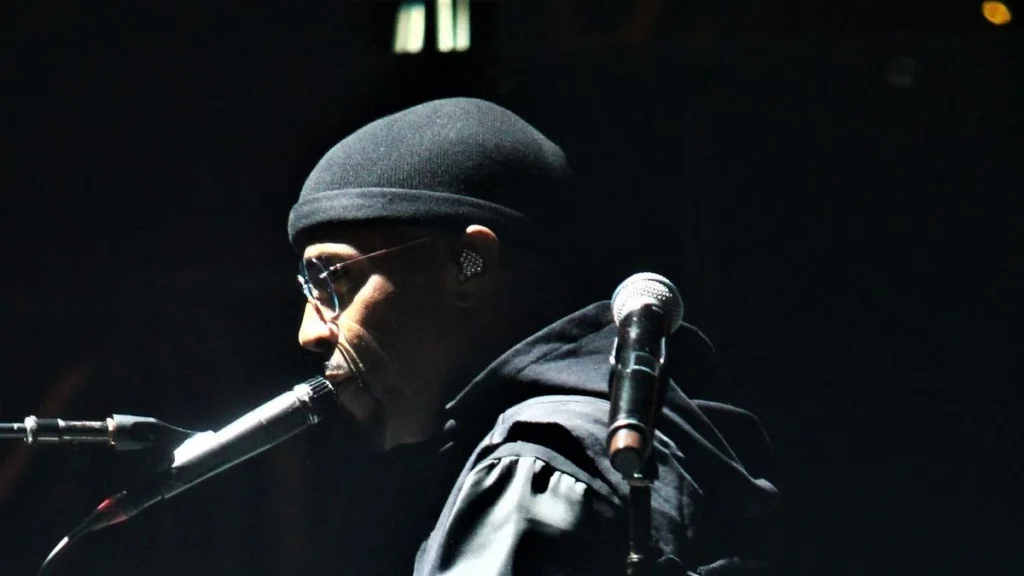
Teddy Riley at a soundcheck.
Teddy Riley at a soundcheck.
Teddy Riley did not name the genre he is credited with inventing. A journalist did it for him, in an interview, because Riley’s own description was too long to print.
“I didn’t make up the name new jack swing,” he told Sound on Sound. “It was given to me by Barry Michael Cooper.”
A Name He Did Not Choose
Cooper, who went on to co-write the screenplay for New Jack City, asked him how he would describe what he was making. Riley’s answer was “sophisticated bubblegum R&B”.
“He said ‘that’s too long, you should call it new jack swing, because you’re the new kid on the block that’s swinging it.’ So I give credit to him for giving me that name.”
What followed is a list Riley recites without much modesty and with no obvious need for it. “I ran with it and everybody joined the movement. Bobby Brown, Kool Moe Dee, Guy, Blackstreet, Boyz II Men, Bel Biv Devoe, New Kids On The Block, N Sync, Backstreet Boys — they made my genre big.”
The phrase he rejected is more accurate than the one that stuck. “Sophisticated bubblegum” describes exactly what the records do: chart-pop immediacy delivered with session-musician precision, which is a harder combination than either half sounds.
Harlem, Thirteen Years Old
It began in Harlem, where a mentor named Royal Bayyan showed him what a studio was. Between the ages of thirteen and seventeen he was sitting in on sessions with Kool & The Gang, Freddie Jackson and Cheryl Lynn.
That is an unusual apprenticeship. Most producers learn the room after they have something to record; Riley learned it before he had anything, watching working funk and soul musicians build tracks while he was still a schoolboy.
It shows in what he built next. The drum programming that made his name is not a rejection of live playing — it is an imitation of it, by somebody who had spent his adolescence watching what a good drummer actually does to a bar.
What the Swing Actually Was
YouKnowIGotSoul puts the technical claim plainly: Riley blended classic soul melodies with hard-hitting, swing-beat percussion, and built a blueprint that prioritised rhythm, syncopation and high-energy production.
The swing feel came from jazz and was executed on the drum machines that had just become affordable. Before it, mainstream R&B ran on mid-tempo ballads; after it, the same music was club-usable without losing the vocal arrangements.
The funk lineage is the part that gets least attention. A swing-beat pattern is a funk drummer’s shuffle programmed into a machine and then hardened, and the basslines under those records are doing what funk basslines do — carrying the groove while the horns and voices sit on top of it.
That is why the sound spread past its own scene so quickly. Producers who came afterwards, Jimmy Jam and Terry Lewis and Dallas Austin among them, folded it into Minneapolis soul and Atlanta funk, and the rhythmic idea survived every stylistic change since.
It also arrived with a look — high-top fades, oversized bright suits, and choreography that assumed the audience wanted to see the dancing as well as hear the record. That combination is why the era is so easily identifiable four decades later.
The Records That Carried It
The production list is long enough to make the genre claim uncontroversial. Keith Sweat’s Make It Last Forever, Bobby Brown’s “My Prerogative”, Johnny Kemp’s “Just Got Paid”, Blackstreet’s “No Diggity”, and a run of records for Heavy D.
Then there is Dangerous. Riley co-produced and co-engineered Michael Jackson’s album, which has sold over 32 million copies, and won a Grammy for Best Engineering in the non-classical category.
That credit is the whole argument in one line. A genre invented for R&B radio was taken up by the biggest pop artist in the world, and the man who invented it was in the room doing the engineering rather than being sampled from a distance.
The Uptown Records era grew out of the same soil, and the sound reached far enough that its rhythmic signature is still audible in the vocal stacking of modern K-pop and in records by Bruno Mars.
The vocal side is the half that gets undersold. Guy, Blackstreet and Boyz II Men all worked with stacked group harmony over those beats, and the tension between a mechanical rhythm and four voices breathing together is precisely what stopped the records sounding like drum-machine exercises. Any producer can programme a swing pattern; arranging a vocal group on top of one is the part that took a musician.
Guy 2.0 and Thirty Arenas
Riley launched Guy 2.0, a new lineup of his original group, in late 2025. Reports of a new jack swing package tour with Tony! Toni! Toné! remain unconfirmed, and the group’s own future is uncertain after the death of founding member D’Wayne Wiggins in 2025.
The revival that is confirmed is larger. Rated R&B reported the thirty-city New Edition Way Tour, powered by the Black Promoters Collective, opening at the Oakland Arena on 28 January and closing at the Toyota Center in Houston on 4 April, with Boyz II Men and Toni Braxton.
New Edition matters here for a specific reason: Bobby Brown and Bell Biv DeVoe both came out of it, and both are central to Riley’s list. The tour name comes from a street in the group’s home city of Boston recently renamed in their honour.
Gary Guidry, chief executive of the Black Promoters Collective, framed it as a collective proposition. “You’re seeing artists who’ve shaped the culture come together to celebrate music that continues to stand the test of time.” Its president, Shelby Joyner, called it “the spirit of collaboration, excellence, and respect for pristine artistry”.
Thirty arenas is a commercial verdict, not a nostalgic one. Acts whose defining records are more than three decades old are filling rooms that most current artists cannot, which says something about how durable a well-made rhythm section turns out to be.
Two-Inch Tape and Studio One
Riley now works from Future Recording Studios 2, built into his house about an hour north of Atlanta. His reason is about the working relationship rather than the acoustics. “It’s all about being intimate with an artist, and to be able to get a lot of work done without anybody knowing.”
The room is a deliberate hybrid: eighties and nineties sound modules, outboard processors, some modern synths, all feeding a DAW running Studio One. He has kept the two-inch tape machine, which he calls “the washing machine”.
His standard for the gear is unfashionably simple. “I like to do a lot of testing with gear. So the things that you see in here are here to stay, because I love the sound of them.”
He is chasing the same result he got the first time. “I try to keep it as close to the sound I used to have, sonically, and it’s very close.” A producer whose entire genre was built on the newest available machines has settled into maintaining a specific tone rather than pursuing the next one.
It is the position a lot of this music’s founders now occupy, holding a sound in place while the rooms around it change — the same territory as Maxwell refusing to release a record until he could perform it properly. The equipment is not the point. Getting it to feel the way it felt is.
About The Author




More Stories
Ethan Campuzano Single HOT SHOWMAN Reunites Lil Tots Before a Hollywood Headline Set
Kirk Franklin Takes the Record Behind Dey Know to Church
The Line From Port Harcourt to Holy Ghost, Where D.A BIZ Sets a Prayer to Afrobeat