
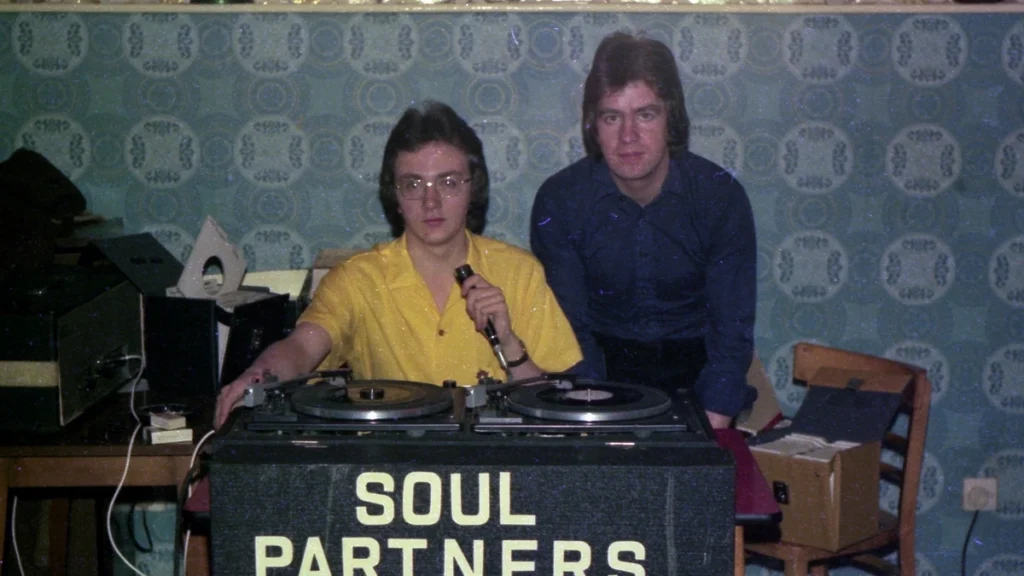
The Soul Partners mobile disco at the Oval Ball Club, Leigh, Lancashire, around 1974.
The Soul Partners mobile disco at the Oval Ball Club, Leigh, Lancashire, around 1974.
A ninety-minute film about northern soul reached British cinemas on 15 May. It has a great deal to say about the dancing, the clothes, the amphetamines and the men who owned the records, and almost nothing to say about the people who made them.
That is not a hostile reading. It is the observation of the writer most sympathetic to the film.
Ninety Minutes on a Former Casino in Wigan
Northern Soul: Still Burning is written and directed by Alan Byron. The Reviews Hub, which scored it 80 percent, sets out the claim it makes: this is the story of how a former casino in Wigan changed the history of music and youth culture.
The cast is the scene’s own establishment. The DJs Richard Searling, Russ Winstanley, Ian Levine and Kev Roberts; the journalist Paul Mason; the designer Wayne Hemingway; the documentary maker Tony Palmer, whose 1977 Granada film supplies footage of Wigan from that year; and Elaine Constantine, whose 2015 feature Northern Soul provides further clips.
From the current scene there is Ady Croasdell, who runs all-nighters at London’s 100 Club, and two young men putting on northern soul nights in Deptford. Tony Blackburn, an accidental northern soul figure, supplies what The Blue Moment calls the film’s comic highlight.
Byron also interviews a fellow director who was sent to capture Wigan Casino for the BBC. Regulars describe what that did to the room — the inconvenience of filming, an influx of new members, and a marked shift towards people who did not get it.
What the Film Leaves Out
Richard Williams, writing at The Blue Moment, is warm about the film and precise about its gap. “The music itself is barely discussed: we don’t hear much about the (mostly) African Americans who made it, or why, or what effect its belated recognition in the UK might have had on them.”
He extends the complaint to the records as objects of craft, wishing for “someone talking about the importance of vibes and baritone sax on so many of the records”. He also notes the absence of the 2023 Northern Soul Prom and the mixed reactions it drew.
The Reviews Hub finds a parallel omission on the other side. The film gestures at deprivation and deindustrialisation without fleshing out the link between the economic collapse of those towns and the scene that grew in them.
Both gaps are versions of the same problem. A subculture film made from the memories of its participants will reliably capture what it felt like to be there, and will just as reliably leave out everything the participants did not need to know at the time.
The Three Before Eight
The single most powerful thing in the tradition is a running order. At the end of a Wigan Casino all-nighter came the “three before eight”: Tobi Legend’s “Time Will Pass You By”, Jimmy Radcliffe’s “Long After Tonight Is All Over” and Dean Parrish’s “I’m on My Way”.
Williams describes what those records contain: “a urgent plea not to waste your life, a pledge of lasting faith, a shout of belief in the value of persistence despite the odds.” On the Casino’s last night, in 1981, Searling played the sequence three times before the doors opened onto the morning.
Those are American soul singles from the middle sixties, made in the ordinary commercial way and mostly unsuccessful. What the scene did was assign them a liturgical function they were never written to serve, then keep them there for fifty years.
It is worth stating plainly what that means. The northern soul canon is classic soul — Detroit, Chicago and points south, cut for a domestic market that ignored it — reclassified by an audience three thousand miles away and two decades late.
Records Nobody Else Had
The Reviews Hub identifies the film’s strongest passage: DJs owning the only copy of a particular record, hunting originals, and building reputations on collections nobody could duplicate. Around it ran the record stalls at every night.
That competitive element is not a footnote to the scene, it is the mechanism. DMovies makes the point that a large part of the draw was simply hearing records unavailable anywhere else, at a time when there was no internet and no other route to them.
A DJ with the only playable copy of a 1966 single held something that could not be bought, borrowed or streamed. Scarcity was the currency, and the scene’s economy of rare 45s is the reason the same records still command what they do.
The name came from a writer rather than the dancefloor. Dave Godin coined it in his Blues & Soul column, describing what the northern clubs were buying, and it stuck to a scene that had not asked for a label.
Williams offers his own transaction from 1972 as evidence of how the supply chain actually worked: at Brian Selby’s Selectadisc in Nottingham he bought the Fuller Brothers’ “Time’s A Wasting” on Soul Clock, and a bootleg of David and the Giants’ “Ten Miles High”. One legitimate American pressing and one counterfeit, bought together over the same counter — which is the trade in a sentence, and a reminder that demand outran the number of copies that had ever existed.
What the Dancing Was For
DMovies places the film in its decade without sentiment: a period of mass unemployment and power cuts, contemporary with Quadrophenia and Babylon. This was working-class music, for a scene built by and for that part of society.
The physical detail carries it. The Reviews Hub notes the loose, comfortable clothing chosen to allow movement in a sweaty hall; DMovies quotes a woman recalling sweat dripping back down from the ceiling of an overcrowded room.
Paul Mason’s four-part summary — the music, the dancing, the fashion and the drugs — is the film’s working thesis. Amphetamines were part of it, and Blackburn is filmed giggling about the pills that circulated around those halls.
DMovies also identifies why the scene stayed underground for so long: it had no visual figurehead. No Kurt Cobain, no Marc Almond, nobody to carry the flag on television. It spread by word of mouth among people who wanted to find each other.
Who It Is For Now
DMovies is blunt that the film “makes little attempt to cater to those uninterested in the genre”, and reads Byron’s purpose as commemoration — getting the memories onto tape before the generation that holds them is gone.
The Reviews Hub sees a split among the survivors: some guard the legacy fiercely, others simply hope it keeps evolving. The film ends with young dancers doing the same steps in different towns, which is an answer of sorts.
The single most affecting contributor, by Williams’ account, is a woman named Marie Gillespie, in whom “decades later, the meaning of it still shines in her eyes”.
What is missing is the other half of that exchange. The gospel-and-soul tradition these records came out of is documented on our own pages through the people who carried it — Mavis Staples still touring at eighty-six — and a film about British devotion to American soul that never asks what the Americans thought has told only one side of a very long conversation.
That is a reason to make the next film, not a reason to skip this one. Byron has preserved a body of first-hand testimony that will not be available much longer, and the records are still there, waiting for somebody to talk about the baritone sax.
About The Author


More Stories
Kirk Franklin Doubts the Fans Who Asked for Old Kirk
Ian Roland Plays a Twelve-String, and the Line Runs Back to Lead Belly
Giuseppe Cucè 21 Grammi and the Line From the Gospel Hammond to Catania