
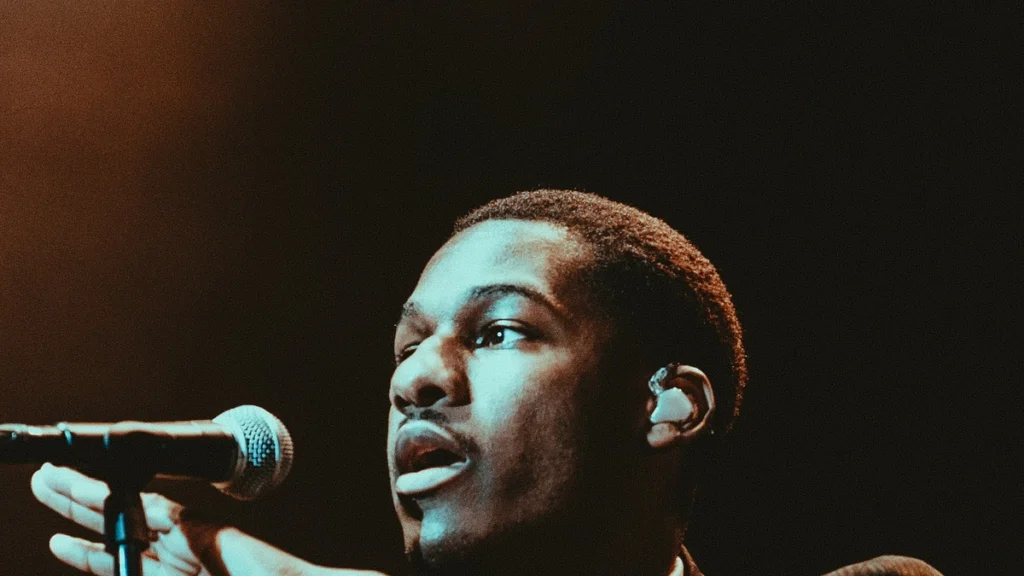
The standard way to introduce an album is one song at a time, spaced over months, each given room to find an audience before the next arrives. On 17 July, Leon Bridges released four at once.
They came from Happiness Anytime, his fifth studio album, due on 25 September through Columbia. Four songs is roughly a quarter of a record, handed over in a day.
Four at Once Is a Bet on Depth
The staggered single is an artefact of how attention used to be bought. Radio needed one song at a time to build a story around, and a label needed months to work each one. Releasing four simultaneously discards that machinery entirely.
What it offers instead is shape. One song tells a listener very little about an album; four tell them what kind of record it is, which is a more honest proposition and a considerably riskier one. If the four do not cohere, the problem is visible immediately rather than in October.
There is a structural reason it works for him specifically. Bridges is not a singles artist in the chart sense; his records have travelled through television placements, festival sets and word of mouth rather than through radio rotation. An artist who does not depend on a single climbing a chart has nothing much to lose by releasing four at once.
It also assumes an audience that will listen to four new songs in one sitting — which is a reasonable assumption for an artist a decade into a career, and a poor one for a newcomer.
A Soul Singer Produced by a Dance Act
The production credit is the genuinely unexpected part. Happiness Anytime was made with J Lloyd-Watson and Lydia Kitto, both of the British group Jungle.
Jungle’s territory is modern funk and dance music built for movement, with vocals treated as one texture among many. Bridges works in almost the opposite tradition: revivalist soul in which the voice is the entire event and the arrangement stays behind it.
Handing a soul singer to producers who habitually bury the vocal in a groove is either a mistake or the point. Given that Bridges has spent several records deliberately moving away from straight 1960s pastiche, it is likely the latter.
He Has Been Widening the Frame for Years
The move fits a pattern rather than breaking one. Bridges arrived as a revivalist — a singer whose music, as one Fort Worth writer put it, sounds like he looks, down to the vintage clothing — and has spent the years since refusing to stay there.
Gold-Diggers Sound in July 2021 pushed toward contemporary R&B. Leon, released in October 2024, followed. Across that stretch his music has ranged from 1960s soul through 1990s neo-soul into something harder to file.
The clearest evidence of his appetite for collaboration outside his lane is Khruangbin. The Houston trio announced a joint project in December 2019 with the single “Texas Sun”, released the EP of that name in February 2020, and returned with a second, Texas Moon, in February 2022. Two EPs with a psychedelic instrumental band is not the behaviour of a purist.
The Jungle pairing also says something about where soul singers now go for production. The obvious choice for a revivalist is a specialist in vintage recording technique — tape, live rooms, period microphones. Choosing two people whose instincts run to loops and dance-floor arrangement means accepting a different relationship between voice and track, one where the singer is part of the groove rather than seated on top of it.
Where the Songs Have Already Travelled
His catalogue has had an unusually visible second life in film and television, which is part of why the name carries beyond soul audiences.
“River” appeared in the first season of Big Little Lies and on its soundtrack in 2017. “Better Man” was used in Pacific Rim: Uprising the following year. He sang at the White House in February 2016 as part of the “In Performance” series, performing a Ray Charles song alongside one of his own, and opened for Harry Styles on the South American and Mexican legs of his first solo tour.
He also turned up outside his own catalogue early, singing on Macklemore and Ryan Lewis’s “Kevin”, which put his voice in front of a pop audience well before most of them knew the name attached to it.
Placement work of that kind tends to fix an artist in one register, because supervisors keep asking for the sound that worked last time. Escaping it usually requires doing something a supervisor would not have picked.
A Career Built Away From Radio
The Khruangbin partnership is worth dwelling on, because it is the clearest evidence of how he actually grows an audience. Two EPs with a Houston instrumental trio, made across 2019 to 2022, produced no obvious radio single and a great deal of reach — the kind of records people pass to each other rather than hear scheduled.
Both were named for the state he comes from, which is not incidental. Bridges has kept Fort Worth in the frame throughout, and the local press has covered each album as a hometown story rather than a national one.
The Precedent for Dumping Singles
Releasing several songs together is not unheard of, but it is normally a response to a leak or a scheduling problem. Doing it by design, more than two months before the album, is a different calculation.
The upside is that a four-track release behaves like a small EP: it can be sequenced, reviewed and played through, and it occupies more of a listener’s time than a single ever will. The downside is that it spends a lot of material early, leaving fewer surprises for release day.
Bridges has been in this position often enough to know the trade. His previous album was announced in the conventional way, with “Peaceful Place” arriving in August 2024 ahead of an October release. Choosing differently this time suggests the record is meant to be heard in blocks. Our piece on the session musicians behind soul’s golden era covers the tradition his early records were reaching for.
What the Album Has to Prove
The other consideration is timing. Four songs in July, an album at the end of September, and a two-month gap in between gives the material time to circulate before anyone is asked to sit with the full record. For an artist whose songs tend to find listeners slowly, through placements and recommendation, a long runway is worth more than a launch spike.
A fifth album from an artist who has already changed direction twice has a specific problem: the audience acquired by the revivalist debut and the audience acquired since do not necessarily want the same record.
Bringing in producers from a dance group is a fairly clear signal about which of those two the album is addressed to. Releasing four songs at once, well before anyone has to buy anything, is a way of saying so early enough that nobody is surprised in September.
Whether the four songs already out are representative or a deliberately unrepresentative sample is the one thing they cannot tell anybody yet. That answer arrives with the other three quarters.
Happiness Anytime is released on 25 September through Columbia.
About The Author





More Stories
Kirk Franklin Takes the Record Behind Dey Know to Church
The Line From Port Harcourt to Holy Ghost, Where D.A BIZ Sets a Prayer to Afrobeat
Why Eyes Closed by STARNAMEDSUN Still Matters to the Lineage of Dark R&B