
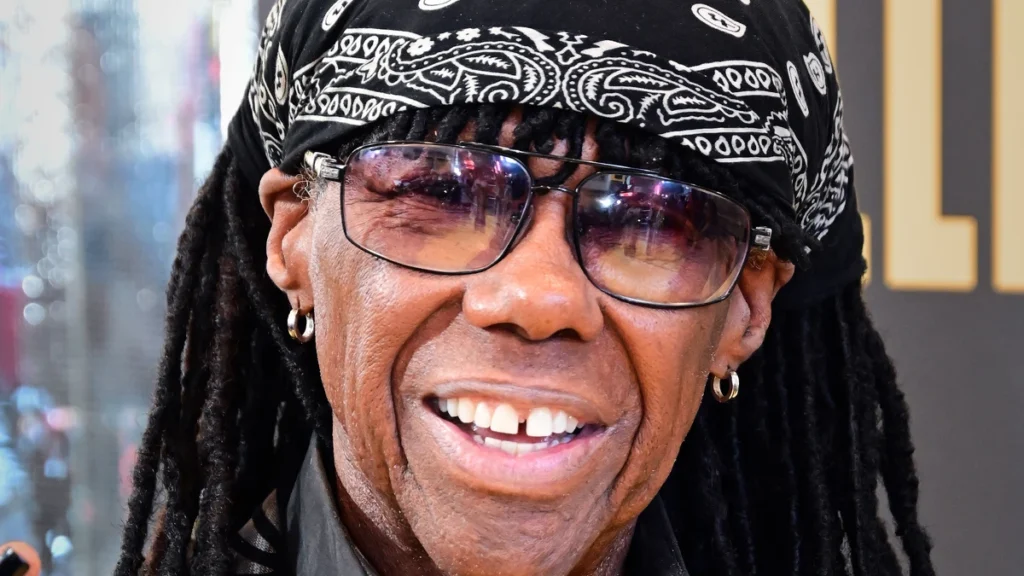
Nile Rodgers in New York, April 2026.
Nile Rodgers in New York, April 2026.
Nile Rodgers turns seventy-four next month. He spent June and July playing fourteen dates across Europe, and he has walked every day for a year while doing it.
The guitar part he wrote for “Good Times” in 1979 has since become, in the standard account, one of the most-sampled songs of all time. Very little else in popular music has been borrowed that heavily by that many people.
Fourteen Dates in Two Months
The summer run was a European sweep rather than a residency. Hampton Court Palace on 17 June, Thetford Forest the following night, TRNSMT in Glasgow on the 19th.
Then the continent: Barcelona on the 21st, Madrid’s Noches del Botánico on the 23rd, Lyon on the 25th, Montauban en Scènes on the 27th. July took in Dublin’s Iveagh Gardens, BST Hyde Park in London, KUNST!RASEN in Bonn, the Royal Park in the Netherlands, LaSemo in Belgium, North Sea Jazz in Rotterdam and the Zénith in Paris.
The venue list is worth reading closely. A palace garden, a forest, a jazz festival, a rock festival and a Paris arena is not one audience — it is five, and a band that can be booked into all of them has stopped belonging to a genre.
His own site quotes the verdict from Glastonbury: fans branding Chic “the best act they’ve seen in years”. That is a specific kind of compliment at a festival where most of the bill is younger than the songs.
The Riff That Built Other People’s Records
Chic began as the Big Apple Band in 1972, Rodgers with the bassist Bernard Edwards. The self-titled debut came in 1977 with “Dance, Dance, Dance (Yowsah, Yowsah, Yowsah)” and “Everybody Dance”; C’est Chic followed in 1978 with “I Want Your Love” and “Le Freak”, which sold more than seven million singles.
Then “Good Times”, from Risqué in 1979, went to number one on both the pop and the soul charts and entered the sampling economy permanently.
What makes the Chic records so reusable is the construction. Rodgers plays rhythm rather than lead — clipped, high up the neck, locked to Edwards’ bass — and the result is a groove with space in it. A part built that way can carry somebody else’s vocal without a fight, which is precisely why so many people have put one on top.
The partnership with Edwards produced work for other artists at the same time: “He’s the Greatest Dancer” and “We Are Family” for Sister Sledge, “I’m Coming Out” and “Upside Down” for Diana Ross.
Writing for other acts while your own band is at number one is not the usual order of things, and it says something about how the two of them worked. Chic was a production company with a band attached rather than a band that occasionally moonlighted, and the songs went wherever the pair judged they would land best — which is why Sister Sledge and Diana Ross both ended up with records that sound like Chic albums and are not.
A Second Career as a Producer
Chic broke up in 1983, and what followed was arguably larger than the band. David Bowie’s Let’s Dance. INXS’s “Original Sin”. Duran Duran’s “The Reflex” and “Notorious”. Madonna’s Like a Virgin.
The list since is almost comically broad: Kylie Minogue, the B-52s, Keith Urban, Jeff Beck, Avicii, Kygo, Daft Punk, Mick Jagger, Coldplay, Bryan Ferry, Christina Aguilera, Lady Gaga, George Michael, Beyoncé.
The awards arrived late and in clusters. Three Grammys in 2014 for Daft Punk’s Random Access Memories, two more in 2023 for his work on Beyoncé’s Renaissance — forty years after Let’s Dance, for doing recognisably the same thing.
That is the unusual shape of this career. Most producers of his generation are remembered for a decade; Rodgers has been the person a major artist calls when they want a record to move, continuously, since the seventies.
Abbey Road and a Cover From 1977
He is Chief Creative Advisor at Abbey Road Studios, and made it Chic’s UK creative base. The studio documented the sessions for It’s About Time, the group’s first album since 1992, recorded partly in its Front Room and Gatehouse.
The single “Till The World Falls” brought in Mura Masa, Cosha and Vic Mensa; the album also features Anderson .Paak and Craig David. Chic played it on Later… with Jools Holland alongside those guests, with NAO on “Boogie All Night”, then went into “I Want Your Love” and “Good Times”.
The sleeve deliberately echoed the 1977 debut, and Rodgers explained why in terms that are not about nostalgia at all. “When I first came up with the concept for the first Chic album cover more than 40 years ago it was a deliberate statement that we could all be abundant, we could all be with the beautiful people, we could all be included, we could all have good times.”
He then said what the reprise was for: “Looking at the world today… I felt that it was important to make those statements again for a new generation.”
Seven Hundred and Fifty Million
The cumulative figure attached to his name is more than 750 million albums and 100 million singles. It is the sort of number that stops meaning anything, so it is worth breaking down what produced it.
A run of Chic hits; a catalogue of songs written for other people; a producer’s credit on several of the largest pop records of the 1980s; and then a third act as the guitarist that dance and pop producers call when they want the real thing rather than an imitation of it.
He is in the Songwriters Hall of Fame, and the New York Times recently placed him among its thirty greatest living American songwriters, with the critic Jody Rosen meeting him in New York to go through how the guitar style came out of the city’s club scene.
That origin matters more than the accolade. The Chic guitar sound was not worked out in a studio and then taken to clubs; it was worked out by watching what a room full of dancers responded to, and reverse-engineering it into a part that would keep them moving. Every producer who has since sampled it inherited that research without paying for it.
Set against the other funk survivors still working, the contrast is instructive. George Clinton is building a spacecraft to tour with; Rodgers simply keeps turning up on other people’s records, which is a quieter way of refusing to stop.
Walking Every Day
The least expected item on his own website is a fitness project. He is taking on a 365-day walking challenge, publishing it as the Walk 365 Club and inviting people to log their own.
For a man who spent 2025 appearing as a surprise guest at Dua Lipa’s sold-out Madison Square Garden show to play “Le Freak”, a daily walk is an oddly domestic footnote. It is also, at seventy-three with a fourteen-date European summer in the diary, a straightforwardly practical decision.
The other continuing project is the We Are Family Foundation, which he co-founded after the September 11 attacks, turning the Sister Sledge song into a programme for young people working on climate, education and social justice. A quarter of the proceeds from his merchandise goes to it.
That is a reasonable summary of the whole career: a song written for somebody else in 1979, still generating money, still being played to a field full of people, and now paying for something entirely unrelated to music.
About The Author




More Stories
Kirk Franklin Takes the Record Behind Dey Know to Church
The Line From Port Harcourt to Holy Ghost, Where D.A BIZ Sets a Prayer to Afrobeat
Why Eyes Closed by STARNAMEDSUN Still Matters to the Lineage of Dark R&B