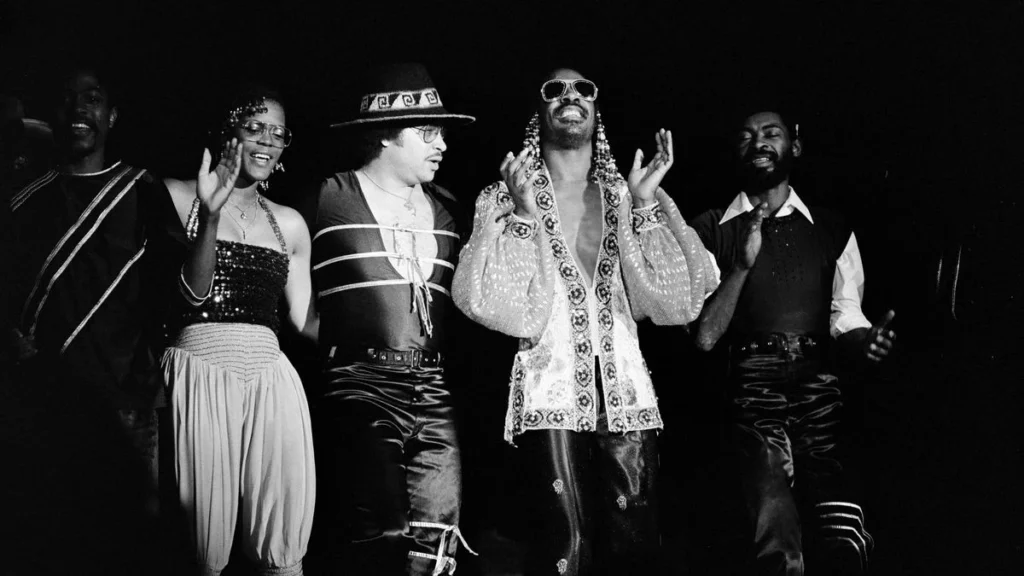
Stevie Wonder and band at Drammenshallen, Norway, in May 1981.
Stevie Wonder and band at Drammenshallen, Norway, in May 1981.
There is a category of Stevie Wonder song that most listeners have never knowingly heard: the ones he wrote, handed to somebody else, and never released himself. Ace Records has now put twenty of them on one disc.
Black America Sings Stevie Wonder, compiled by Mick Patrick, arrived in June alongside a companion volume on Smokey Robinson, both timed to Black Music Month.
The Songs With No Original
Ace is specific about which tracks fall into this category, and the list is startling.
“Tell Me Something Good” by Rufus featuring Chaka Khan. Marvin Gaye’s minor-key “You’re The One For Me”. Margie Joseph’s version of “To Know You Is To Love You”, first recorded by Syreeta. “Open Up Your Heart” by LaBelle. “Bad Weather” by the early-seventies Supremes. Betty Wright’s “What Are You Going To Do With It”, which she co-wrote. And the Four Tops’ “What Else Is There To Do (But Think About You)”.
All of them, in Ace’s phrasing, are “great Stevie Wonder songs with no known recording by the man himself”. A songwriter at the height of his powers was writing material this strong and letting other people have it outright.
There is also Randy Crawford’s “We Had A Long So Strong”, which began life as an album track by Smokey Robinson & the Miracles — a Wonder song, given first to one Motown act and then reclaimed by a singer from outside the building.
Jermaine Jackson’s Rescue Record
The compilation opens with a case study in what a Wonder song could do for a career in trouble.
When the Jackson 5 left Motown in 1975, Jermaine stayed behind and went solo on the label. Ace describes what followed as “a string of underwhelming releases”, after which he called Wonder in to help with his sixth album.
Wonder co-produced it and took writing and performance credits on three tracks, including the title song “Let’s Get Serious”. Ace hears him everywhere on it: “from Jackson’s vocal inflections to the unmistakable sound of its co-writer’s backing vocals, drums, piano, guitar and synth.”
That is the whole argument for a compilation like this. A record filed under one artist’s name can be, in most of its audible components, somebody else’s work, and only a reissue label going back through the credits ever points it out.
What the Covers Do to the Songs
The other half of the set is more familiar material heard through other voices. Aretha Franklin’s 1973 hit “Until You Come Back To Me (That’s What I’m Gonna Do)”. Quincy Jones’ version of “Superstition”, with Wonder himself among the backing vocalists. The Bar-Kays taking on “I Was Made To Love Her”.
The most unexpected is Sylvester’s treatment of “Living For The City”, which Ace calls “fervent electro-gospel” — a disco singer rebuilding Wonder’s examination of racial injustice, class and migration in an entirely different idiom.
It closes with Lou Rawls’ reading of “Evil”, from his 1972 album A Man Of Value. That song also closed Wonder’s own Music Of My Mind, so the compilation ends where one of his albums did, in another man’s voice.
SoulMusic.com picks out Nancy Wilson’s “Uptight” among the highlights, which is its own kind of translation — a jazz singer taking a record built on one of the most physical basslines Motown ever cut and finding the phrasing in it.
Ace’s own summary is the point: the collection shows “the reverence in which he is held among the Black Americans he was writing for and about”.
That framing matters more than it might appear. A “Songbook” compilation usually means a white audience discovering a Black writer through cover versions; the “Black America Sings” series inverts it deliberately, presenting the covers as an internal conversation between artists who shared the same audience and often the same label.
A Hundred and Fifty Copyrights
The companion volume takes on a harder problem. Ace describes Smokey Robinson’s catalogue as “a treasure trove that numbers over 150 published copyrights”, from which the Songwriter Series had to pick two dozen.
Robinson fronted the Miracles for more than fifteen years and was part of the original backroom team at Berry Gordy’s fledgling company, writing and producing not only his own group’s records but those of several other Motown singers. He wrote and recorded “Shop Around”, the label’s first million seller, which is where the compilation gets its name.
Ace is candid that the selection left a great deal behind: there was “not room to include many other songs of comparable quality”, and a second volume is “not beyond the realms of possibility”. It also notes, plainly, that Robinson is still touring in his eighties.
From Merseybeat to Reggae
What the Robinson set demonstrates is reach rather than depth. SoulMusic.com lists the Motown side of it — the Contours’ “First I Look At The Purse”, the Temptations’ “I Want A Love I Can See”, Marvin Gaye’s “One More Heartache” — and then the part that surprises.
The Beat’s “The Tears Of A Clown”. Elvis Costello and the Attractions covering Chris Clark’s “From Head To Toe”. Helen Shapiro’s “My Guy”, which the reviewer rates as “an extremely credible job”. Sonny & Cher’s “You’ve Really Got A Hold On Me”, from their million-selling 1965 debut. Ella Fitzgerald on “Get Ready”, Little Richard on “The Way You Do The Things You Do”, Bettye Swann on “Don’t Look Back”.
Ace’s description of the spread is compact: covered “by all manner of artists in all genres of music, from Merseybeat to reggae”. Kiki Dee qualifies as a Motown artist here on the strength of one album released in 1970. Tony Rounce compiled the set and wrote the booklet notes.
Why This Work Still Matters
Compilations like these are frequently dismissed as catalogue-mining, and the dismissal misses what they do. A songwriter’s body of work is scattered across dozens of artists, labels and decades, and nobody encounters it as a body unless somebody assembles it.
The Wonder set in particular reframes a career. He is understood as a performer who wrote his own material; the evidence here is of a working songwriter supplying other people at a rate that leaves songs permanently outside his own discography.
Ace and its Kent imprint have been doing this long enough to have shaped what British listeners think Sixties soul sounds like. The rare-soul market that grew up around northern soul all-nighters ran on records the American industry had written off, and the reissue label is the mechanism that turned a collector’s private stack of 45s into something anybody could buy. A compilation is not a substitute for the original pressing, but it is the only version of the archive most people will ever hold.
It fits the wider pattern of a Motown catalogue still being actively worked rather than simply archived — the same summer that Martha Reeves revived a Sixties Motown recording that the company shelved and put it on a new album at eighty-five.
Both compilations end on the same observation, made independently by two different writers: the men who wrote these songs are still alive, still working, still touring. Ace’s Wonder page puts it simply — “he’s still out there today, still doing his thing” — and its Robinson page notes he is touring in his eighties. The archive is not closed, which is precisely why somebody should be keeping it in order.
About The Author




More Stories
Kirk Franklin Doubts the Fans Who Asked for Old Kirk
Ian Roland Plays a Twelve-String, and the Line Runs Back to Lead Belly
Giuseppe Cucè 21 Grammi and the Line From the Gospel Hammond to Catania