
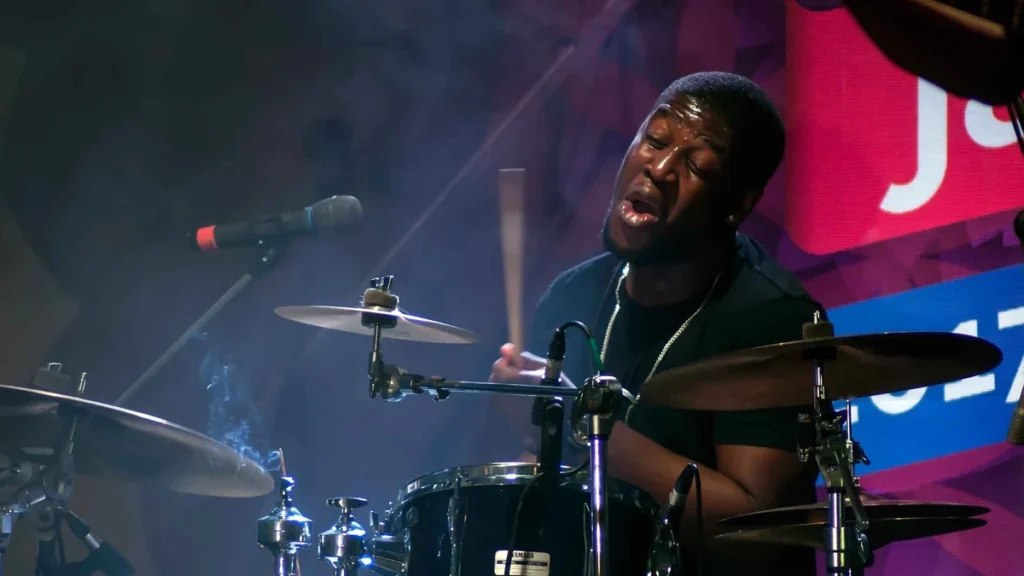
In 2024, playing Wembley Arena, Ezra Collective looked out at their own crowd and saw the rapper Pa Salieu in it, dancing with his friends.
That was the moment the song started. “I had the very thought,” the band recalled, “we need to make a song together for this kind of setting.” Two years later it is “Only Love”, the lead single from Here Because of Hope, out on 18 September.
A Song Written for a Room That Already Existed
Ezra Collective have never been a jazz band in the narrow sense — the group’s sound folds afrobeat, calypso, reggae, hip-hop and soul into the jazz, which is why a rap feature does not require a detour.
Most collaborations begin with a management email. This one began with a sightline — a band on stage noticing who was enjoying it, and working backwards from the reaction to the record.
That order matters. Writing a song for a room you have already stood in is a different exercise from writing one you hope will fill a room later. The tempo, the volume and the space between the drums are all decided by something the band has already watched happen.
It also explains why it took two years. A song built to a remembered feeling is not a scheduling problem; it is a slow one.
The Research Was Literal
The band did not simply invite Pa Salieu on. They went and studied.
“I spent some time studying West African music, studying Gambian music,” the group said, “and let that influence the bassline of this track and the drumbeat.” Pa Salieu’s Gambian heritage is not treated as a guest-verse garnish but as something the rhythm section was rebuilt around before he arrived.
What they admired in him, by their own account, was not only the lyricism and the storytelling but his ability to weave that heritage into a distinctly UK sound. Meeting him halfway meant learning the other half.
The video went to the same place the music did. It was shot on location in Lagos by Ebenza Blanche, whose other work includes Little Simz.
A Band That Grew Up in Public
The framing the group have given the album is generational rather than musical. Their earlier records, they say, were Ezra Collective as children; this one is Ezra Collective as adults.
The claim is literally true. The quintet — drummer and bandleader Femi Koleoso, bassist TJ Koleoso, keyboardist Joe Armon-Jones, trumpeter Ife Ogunjobi and tenor saxophonist James Mollison — met at Tomorrow’s Warriors, the jazz youth programme, and formed the group soon afterwards. The band is the thing that grew up, not a name that survived a series of line-ups.
That is a literal description as much as a figurative one. The group formed as teenagers and the same core has stayed together, so a fourth album is arriving from five people who have known each other since school — “five adults that met as children”, as they put it.
Bands that form young usually lose members to the obvious pressures. Staying intact long enough for the change to be from childhood to adulthood rather than from one line-up to the next is the rarer outcome, and it is what makes the claim more than a press-release flourish.
The Accolades Arrived Before the Adulthood
What makes the growing-up framing slightly funny is how decorated the childhood was. They won the Mercury Prize in 2023, and at the Brit Awards in 2025 became the first jazz band ever to take Group of the Year.
Their 2024 single “God Gave Me Feet for Dancing” was picked by Barack Obama for his twenty-five favourite songs of that year, which is the kind of endorsement no campaign can manufacture.
A band that has already done all that calling its fourth record the first adult one is either false modesty or a genuinely different standard. Given the album’s stated subject, it reads as the second.
Joy With the Pain Left In
The record’s argument is stated plainly enough to be tested against the music. The band describe being unable to look at the world without feeling deep pain and sadness, while still being determined to write an album whose final destination is joy.
“This album is the journey from that pain to joy,” they said, “and the connective word in the middle is hope.” Hence the title.
It is a harder brief than either pure celebration or pure lament. A joyful record that ignores the reason joy is difficult reads as naive; one that dwells only on the difficulty abandons the dance floor entirely. Placing hope as the hinge is a structural decision about sequencing as much as a thematic one.
Their stated aim is blunt: they hope it makes people dance, and they hope it makes people cry.
They have also kept the London jazz scene close rather than outgrowing it, working repeatedly with peers such as Nubya Garcia and Moses Boyd. A band four albums in that still records with the musicians it came up alongside is describing the same continuity the album title gestures at.
Where the Band Is Right Now
The album arrives after a stretch that has been quietly busy rather than loud. They picked up a Jazz FM award recently, then played a back-to-roots anniversary show in Hackney Wick — a deliberate return to the kind of room they started in, at the point their venues had stopped resembling it.
Playing a small east London show in the same period as an arena career is a legible signal about what the band think they are. It also sits oddly well beside an album about growing up.
The record lands through Partisan Records, an independent, which is worth noting for a group whose profile could comfortably have taken them elsewhere.
Why This Pairing Is Not the Obvious One
A jazz band and a rapper is a familiar combination on paper and a difficult one in practice. Jazz players improvise around a soloist; a rap vocal usually wants a fixed grid to sit on.
Pa Salieu is a well-chosen counterpart for it. Pa Salieu Gaye broke through in January 2020 with “Frontline”, the most-played track of that year on BBC Radio 1Xtra, and released the mixtape Send Them to Coventry that November. His style already blends afrobeats, grime and UK drill, so the meeting point the band went looking for was one he had been working in for years.
Building the track from West African rhythm rather than from a straight-ahead jazz feel is what resolves that. Afrobeat gives both parties something to hold: a repeating figure with room to move over it, which is closer to what a rapper needs than a chord sequence that keeps turning over.
Our piece on afrobeat and afrobeats, one letter and two genres covers the distinction the band are drawing on here.
Two years between a glance across an arena and a finished single is slow by any commercial standard. It is also, on the evidence of how the track was built, roughly how long it takes to do it properly.
Here Because of Hope is released on 18 September through Partisan Records. “Only Love” is out now.
About The Author

More Stories
Andrew Moore and Hooch Trace the Line From Blues to Orbit on “Spaceman”
Kirk Franklin Doubts the Fans Who Asked for Old Kirk
Ian Roland Plays a Twelve-String, and the Line Runs Back to Lead Belly