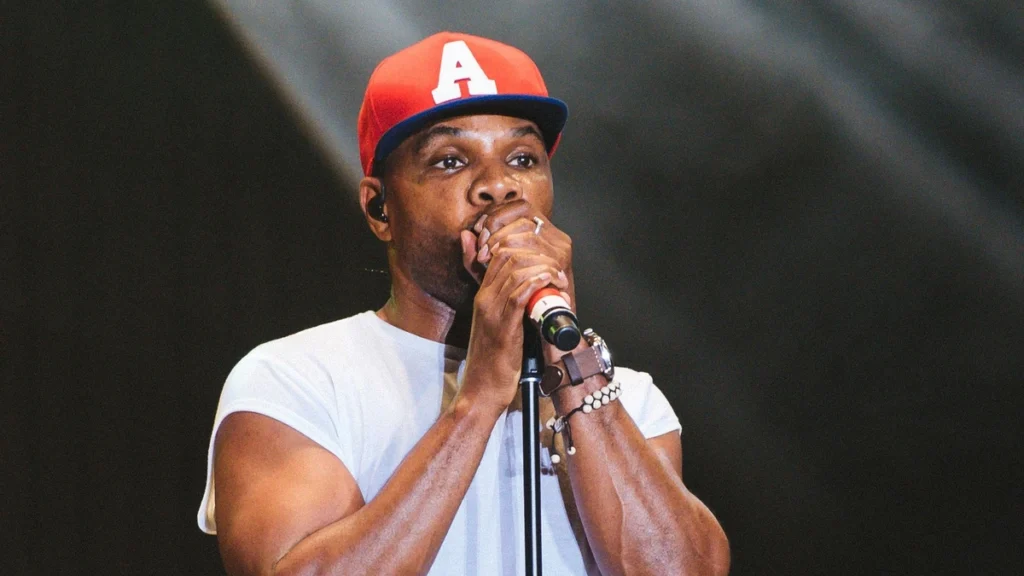
“Thank You for Everything” is built the way gospel records were built before the crossover era: a live room, a choir, Karen Clark Sheard on the feature, and an arrangement that leaves space for a congregation to answer back. It is the first release from a double album, and Kirk Franklin describes it in terms of a specific year.
“It’s new, but it’s old,” he told Erica Campbell on Get Up! Mornings. “It’s very 1992 Kirk. It’s very… Silver and Gold live church album Kirk.”
What makes the project interesting is not the return itself. It is that he is openly sceptical about whether the people asking for it will show up.
The Quote That Complicates the Comeback
Artists returning to an earlier sound normally frame it as giving the audience what it has been requesting. Franklin did the opposite, and named the gap between what listeners say and what they play.
“There was a lot of trepidation,” he said. “People kept saying they wanted church music, they wanted old Kirk. But I’m not seeing y’all listening to other people’s church music.”
That is an unusually direct observation about a demand that does not appear in the numbers. Traditional, choir-led gospel occupies a smaller share of streaming than its cultural standing implies, while contemporary gospel and gospel-adjacent R&B travel much further on playlists. A request for old Kirk is often a request for a memory rather than a listening habit, and he has said so out loud rather than pretending otherwise.
Eighteen Months, His Longest Since the First Record
He put nearly a year and a half into the album, which he says is the longest he has spent on anything since the beginning of his career.
“I’ve never worked on an album as long as this,” he said. “Probably the only album I worked on this long was my very first album.”
The symmetry is neat but the reason is practical. Live church recording is unforgiving in a way studio work is not. A choir, a rhythm section and a congregation are captured together, the take either has the feeling or it does not, and the fixes available afterwards are limited. Franklin also said many songs did not make the final cut, which is what that process tends to produce: a lot of material recorded to find the handful that actually caught.
He described the return to the choir-driven sound as intimidating, because gospel has changed substantially since the records that made his name.
Seven Live, Seven Studio, Two Stories
The album is 14 songs split evenly. “It’s gonna be a double album,” he said. “It’s gonna be two different stories from one person.”
Seven live church recordings and seven studio tracks is a structure that refuses to choose, and it is a more honest solution than the alternatives. A wholly traditional record would test his own scepticism about the market directly. A wholly contemporary one would ignore the request entirely.
Splitting it lets both versions exist without either being a compromise of the other. The live half can be built for a room; the studio half can be built for headphones and playlists. They are different productions serving different listening situations, which is precisely why blending them into a single hybrid usually satisfies nobody.
Franklin has been on both sides of this for three decades. The crossover run that produced I Smile and Love Theory moved gospel into general rotation and drew the familiar accusation of dilution. He referred to that material jokingly as “ratchet Kirk” in the interview, while Campbell named the new version “churchy Kirk” — a two-word summary of a career-long argument that gospel has been having with itself.
The Younger Names on the Credits
Melvin Crispell III, Lena Byrd Miles and Carson Barnes all appear on the project, and Franklin was explicit about why.
“I just enjoy working with anybody that’s hungry,” he said.
This has been a consistent pattern rather than a one-off gesture. Franklin’s records have functioned as an entry point for gospel singers and players for most of his career, and a feature on one of his albums has repeatedly been the moment a name reaches beyond the church circuit.
It also solves a real problem for a live church album in the present. The sound he is reaching for was made by musicians who grew up inside that tradition, and the players who can execute it convincingly now are younger than the records being referenced. Casting from that generation is how the live half avoids becoming a reconstruction.
Karen Clark Sheard Is the Right First Feature
Putting Clark Sheard on the lead single is a statement of intent that requires no explanation to a gospel audience. Her voice carries the lineage the album is claiming, and the pairing signals immediately which half of the record the single belongs to.
It also sets expectations correctly. Leading with a studio track would have implied a contemporary album with some church material attached. Leading with a live recording featuring a singer of that standing tells listeners the traditional half is the argument, and the studio half is the other story rather than the main one.
Lineage is the recurring subject on this desk. Our recent piece on the line from the gospel Hammond to Catania follows the same instrument into an entirely different scene.
What 1992 Actually Sounded Like
Invoking a specific year rather than a vague earlier era tells you what he is reaching for. The early-nineties gospel Franklin is naming was defined by a particular production approach: the choir recorded in the room rather than stacked in overdubs, a rhythm section playing to the singers instead of to a click, and arrangements that left deliberate holes for a congregation to fill.
That last point is the hardest to reproduce. A live church record is not simply a studio record captured in a church. The congregation is part of the arrangement, responding on cue and shaping how long a vamp runs, and a section can extend or collapse depending on what the room does. Recording it means accepting that the take’s length is not fully under the producer’s control.
Silver and Gold, the album he referenced, came out of that tradition, and the reason the sound has been difficult to revive is not nostalgia or technique. It is that the economics of modern release schedules favour material that can be finished predictably, and a live congregational record cannot be. Eighteen months and a pile of discarded songs is the actual cost of doing it properly.
It also explains the structural choice of a double album rather than a hybrid. Attempting to fake congregational energy inside a studio production is the compromise that has produced a great deal of unconvincing gospel over the past two decades, and keeping the halves separate avoids it entirely.
What the Record Is Really Asking
The question underneath the project is whether an audience’s stated preference can be converted into listening. Franklin has effectively built the experiment and said in advance that he doubts the result.
If the live half performs, it becomes evidence that the demand for traditional gospel is real and had simply not been supplied at this level of production and promotion. If the studio half carries the streams, it confirms his suspicion and tells every gospel artist watching that the nostalgia expressed in comments does not translate into plays.
Either way the answer will be legible, because the two halves are on the same release, by the same artist, promoted together. That is a cleaner comparison than the genre usually gets, and it is the most useful thing about the record before anyone has heard it.
Making that test in public, and admitting the trepidation while doing it, is a more interesting position than a straightforward return to form. He has committed eighteen months to a sound he is not certain the market wants, and said as much on the radio.
About The Author

More Stories
Ian Roland Plays a Twelve-String, and the Line Runs Back to Lead Belly
Giuseppe Cucè 21 Grammi and the Line From the Gospel Hammond to Catania
Ibibio Sound Machine Produced Chopping Mountain Themselves Again