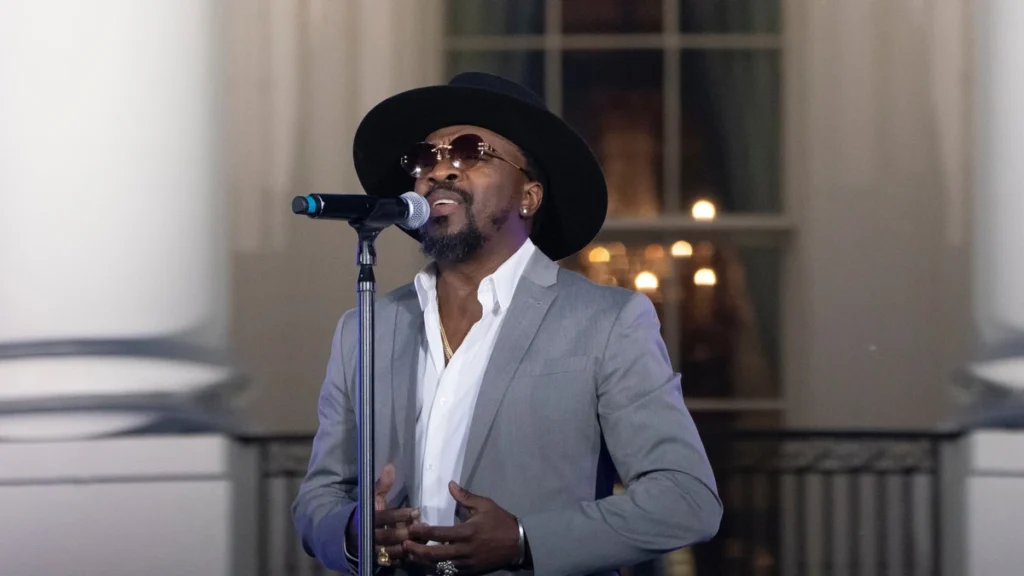
Anthony Hamilton performing at a Juneteenth concert on the South Lawn of the White House.
Anthony Hamilton performing at a Juneteenth concert on the South Lawn of the White House.
Two weeks before he died, D’Angelo rang Anthony Hamilton. Hamilton did not get to the phone in time.
“By the time I got to the phone and realized it was him, I called him back, he didn’t pick up,” he told Rolling Stone. D’Angelo, who called him Ant-eezy, died on 14 October 2025.
The Call He Did Not Answer
When the news came, Hamilton started working through what the conversation might have been. What he settles on is not regret about information but about acknowledgement — it could have been a chance to thank the man he counts as one of his most important mentors.
“Man, I come from a good school,” he says.
CBS News reported the death that Tuesday; his family confirmed he had died after a “prolonged and courageous battle with cancer”. He was fifty-one. He had been booked to headline the Roots Picnic earlier that year, with Maxwell announced as his replacement months before the end.
A Shelved Album That Led to the Job
Hamilton’s route into D’Angelo’s band came through his own career failing.
He had a debut album called XTC that would have arrived around the same time as Brown Sugar in 1995. It was cancelled when Uptown Records folded.
“That’s how he became aware of who I was as an artist,” Hamilton says. “I got the call once he realized my album didn’t come out and Uptown Records had folded.”
That is a specific kind of generosity, and worth naming as such. A rising artist noticing that a peer has been dropped, and hiring him rather than commiserating, is not the standard behaviour of the industry.
It also placed Hamilton somewhere unusually instructive. Background singing on a major tour is one of the few remaining apprenticeships in this music — paid work, nightly repetition, and a view of how a bandleader actually runs a room, without the responsibility of being the person the audience came for. Hamilton got eight months of that at exactly the point his own career had stalled, which is why he describes the tour as an education rather than a job.
Seventy-Seven Shows in the Background
The Voodoo world tour was Hamilton’s first. He spent eight months in the Soultronics, the thirteen-piece band, harmonising and improvising behind a man who was rebuilding the foundations of soul music in public.
The run covered seventy-seven shows across the United States, South America and Europe. His description of what it was like out front is the best thing in the interview.
“Every night, you’d see people come out there just to be engulfed in something so powerful that they couldn’t even get their breath right. You didn’t know whether you were feeling church, rock & roll, blues or whatever it was. You just knew it was something that you hadn’t felt in 100 years or more.”
What he took from it was structural. “I came back better. I learned a lot from watching from that perspective, from the background. You learn how to be a leader when you can follow somebody as great as D’Angelo.”
The work went on off stage too. “On our lunch breaks, instead of going to eat just to be eating, we’d be going over parts.” The arrangements Hamilton later brought to his own records — “Charlene”, “Point of It All” — came out of that habit.
How the Voodoo Shows Ended
The tour began two months after the album, and most nights closed the same way, with “Untitled (How Does It Feel)”.
The song was, as Rolling Stone puts it, a double-edged sword: its video made D’Angelo enormous and left him deeply uneasy about being received as a sex symbol rather than a musician. That discomfort is part of why he then spent much of a decade out of view.
The staging of it was extraordinary. As the chorus repeated, one member of the Soultronics would unplug and walk off after each “how does it feel”, until D’Angelo was alone.
Hamilton was usually second-to-last to leave. “Such a spiritual moment,” he says. “He’d be the last one playing, and he’s singing, and it’s just ringing out … That was genius. What a big loss.”
As a piece of stagecraft it does something no encore can. Subtracting the band one player at a time forces the audience to hear the arrangement dismantled, part by part, until only the voice and one instrument remain — a demonstration of exactly how much was holding the song up, performed in reverse.
What the Genre Lost
The scale of it is easy to state and hard to absorb. Brown Sugar is the record generally credited with starting neo-soul. Voodoo went to No. 1 and won Best R&B Album, with “Untitled” taking Best Male R&B Vocal Performance, and it sits at number twenty-eight on Rolling Stone’s list of the greatest albums ever made.
He sang on Lauryn Hill’s “Nothing Even Matters”, worked with Angie Stone and Erykah Badu, and was a Soulquarian. He made three albums in thirty years, the last being Black Messiah in 2014, and was inducted into the National Rhythm & Blues Hall of Fame in the year he died.
Three albums is the number that explains the reverence. He was not prolific and never tried to be, and every record arrived after a long enough silence to have been genuinely awaited. The gaps were not strategy either — Wikipedia’s account is blunt about the depression, the drug addiction and the alcoholism that kept him out of view, and the cost of those years is part of the record too.
The label he is credited with founding has never sat comfortably on anyone. Eric Benét dislikes being filed as neo-soul and finds the term limiting; D’Angelo’s own records outran it within one album. It stuck anyway, because somebody had to name what Brown Sugar did.
Untitled, Added to the Set
Hamilton is currently out on a run called Soul on Tour, and is making room in it. He plans to add “Untitled” to the setlist, performed with his band the Hamiltones, in a way he hopes brings “the spirit of D” into the room.
His account of the relationship is unguarded. “He loved me. I know he loved me, and he was proud of what I represented for the Black culture and music, and he thought my voice was something special.”
What he wants people to take from the catalogue is not technical. D’Angelo’s example, he says, teaches that “it’s OK to be naturally and authentically Black in your music”.
He extends it into a complaint about the present, and it is worth quoting in full because it is more precise than most such complaints: “I don’t think they know how to reconnect with love and passion and still be funky, still be gangsters, still be hood, you know, and make it beautiful. Put respect back into the music. Put music back into the music. And it’s OK to take your time.”
The last clause is the one D’Angelo actually lived. Fourteen years passed between Voodoo and Black Messiah, and nobody now argues it was time badly spent. It is also, in an industry that measures artists by release cadence, the hardest piece of advice he left behind to actually follow.
About The Author


More Stories
Kirk Franklin Takes the Record Behind Dey Know to Church
The Line From Port Harcourt to Holy Ghost, Where D.A BIZ Sets a Prayer to Afrobeat
Why Eyes Closed by STARNAMEDSUN Still Matters to the Lineage of Dark R&B