
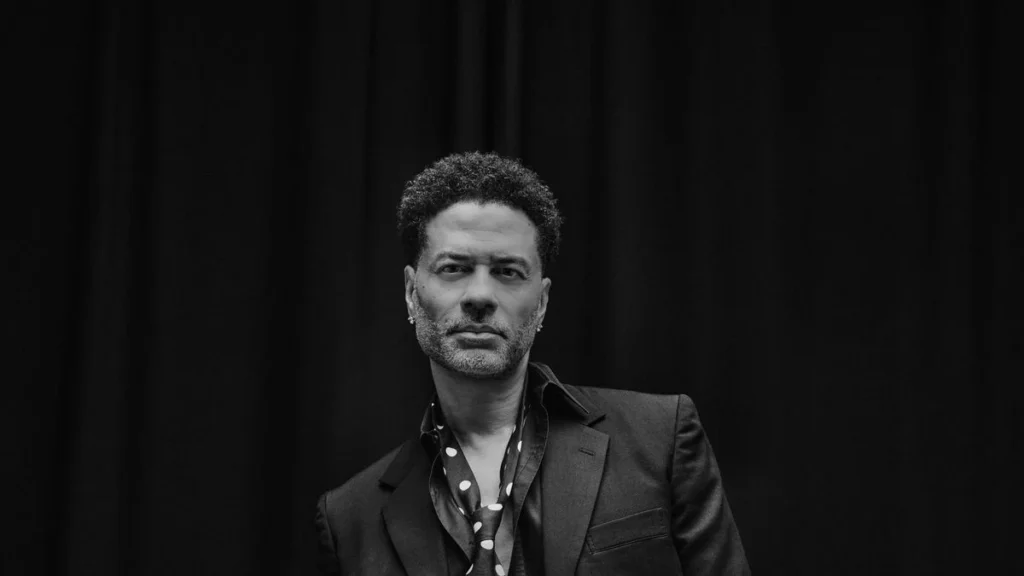
Eric Benét, photographed for The Co-Star.
Eric Benét, photographed for The Co-Star.
Eric Benét’s ninth album has thirteen tracks and a guest on every one of them. All of the guests are women. He called the record The Co-Star and put himself in the supporting role.
It was not his idea. “It was Alison’s idea,” he told Rolling Stone, of Allison Ball, the CEO of his label. “She was like, look at some of your biggest songs — ‘Georgy Porgy’ with Faith Evans and ‘Spend My Life With You’ with Tamia. You should do a whole album like that.”
An Executive Who Read the Catalogue
Ball is a former Warner Music executive whom Benét recruited to run JBR Creative Group after concluding, sensibly, that he was a creative rather than an executive. Her first instruction to him was to look at his own chart history.
She was right about it. The two songs she named are the ones a general audience knows, and both are duets. An artist thirty years into a career rarely gets told something that obvious about his own work, largely because nobody around him is reading the data.
The idea was tested before it was committed to. A five-track EP, Duets, arrived in 2024 on the same principle, and “So Distracted” with Chanté Moore reached the top ten of the Adult R&B Airplay chart. Only then did the full album get built.
Thirteen Duets and No Men
The Urban Music Scene published the track list in May. It runs: Ari Lennox, Alex Isley, Keri Hilson, India.Arie, Corinne Bailey Rae, Tamar Braxton, Judith Hill, Goapele, Melanie Fiona, Jordin Sparks with Autumn Paige, Chanté Moore, the Brazilian trio SalDoce, and Pia Toscano.
That is four Grammy winners, several multiple nominees, one bossa nova trio and at least one artist releasing her first significant feature, arranged across a single record. Assembling it required thirteen separate negotiations, which is the part of the concept nobody puts in a press release.
The title came from one of the guests. Benét had been stuck for a name for weeks when he did a session with Keri Hilson in Atlanta. “I was talking to her about it, and off the dome, she was like, ‘How about Co-Star?’ I was like, ‘Girl, that sounds good!'”
The producers were chosen the same way — for currency rather than familiarity. Darhyl Camper, Cardiak, Antonio Dixon, Randy Emata and Laney Stewart worked on the record alongside Benét, a roster assembled specifically because he was after a contemporary sound rather than a reproduction of his own back catalogue. A singer who wanted to make a heritage record would have called the people who made the first ones.
The Song Corinne Bailey Rae Turned Down
His method for writing a duet is to write towards the other singer. “When I write music, especially for a duet, I fixate on that artist, their timbre and cadence,” he said.
For Bailey Rae he heard something Latin. “I heard a melody that was Latin or bolero-like. And I was like, ‘Oh, my God, Corinne’s timbre singing this would crush people.'” He demoed it, sent it to London, and was declined politely: “She said, ‘Oh, this is really lovely. I don’t think it’s me, though.'”
The song survived the rejection. It became “Eres Mi Vida” with Pia Toscano, closing the album, and it took Benét somewhere his catalogue usually avoids. “I wanted to write a song that felt like you fell in love with someone at a time where you had almost written off love. And not only did you fall again, but you fell in love so hard that if this person left you, you would just cease to exist.”
He is explicit that this is against his own habit. “I don’t like writing those kinds of songs. I like to claim power, like: I’m a powerful entity, you’re a powerful entity — how about we be powerful entities together and go through life like that.”
Bailey Rae is still on the record, on “Fly Away”, which Rolling Stone describes as the two of them taking turns in falsetto until the voices intertwine. A collaborator who says no to one song and yes to another is a working relationship rather than a booking.
No Album Chart, Two Number Ones
The record did not chart at all. It also produced his highest-charting singles in years: “So Distracted” with Chanté Moore and “Something We Can Make Love to” with Tamar Braxton both reached No. 1 on the Adult R&B Songs chart.
Those two facts belong together. Adult R&B radio is where slow songs for grown listeners live — the format the quiet storm invented — and it operates almost entirely independently of album sales. A record can be commercially invisible on the Billboard 200 and simultaneously be the most-played thing on a specific dial.
Benét has spent his career in that territory. “I Wanna Be Loved”, “Spend My Life With You” and “Sometimes I Cry” are late-night songs built on a falsetto he can still reach, which is the whole technical requirement of the format.
It is worth noting what an independent release changes here. Working through his own label meant nobody had to be persuaded that an all-female duets album was commercially sensible, and nobody had to defend an album that missed the chart.
A Label He Does Not Want
Rolling Stone notes that Benét is often filed under neo-soul and does not care for it, finding the category too limiting. The Co-Star reads as an argument against the box: bossa nova on “Too Soon”, orchestral arrangement on the closer, and a first recorded curse on the opening track “Gaslight” with Ari Lennox.
Cursing for the first time in three decades of records is a small thing that tells you what the album is for. He is not protecting a brand built in 1996; he is using the freedom of a project nobody else is paying for.
There is a version of this argument running right across the genre. Buju Banton spent an interview rejecting the term trap dancehall for his own scene, and Benét is doing the smaller domestic version of it — refusing a category that was applied to him rather than chosen.
Milwaukee, by Way of Mobile
The album’s most serious song is the one furthest from the concept. Benét grew up in Milwaukee, the youngest of five, to parents who had moved more than a thousand miles north from Mobile, Alabama, to get away from the racism they were raised in.
“My mother would tell me stories about when she was 13 and she and her sister couldn’t walk home a certain way because they would be chased,” he said. “Southern Pride”, his duet with Judith Hill, is where that goes, in a line about the northern states offering “a lighter shade of hate to raise a family”.
He credits the Methodist church of his childhood with teaching him to perform rather than with his beliefs. “I found that if my voice was true and strong and it rang true in my mind, the front row of the old lady nurses would get happy. That’s power right there.”
He is fifty-eight, spent the spring of 2025 opening for Musiq Soulchild and Joe on the R&B Invitation Tour, and headlined the Kings Theatre in Brooklyn — a room that has become the default venue for exactly this kind of career, as Maxwell’s own residency there demonstrates. Making the least conventional album of that career at this point, and giving the top billing away, is the more interesting move.
About The Author




More Stories
Kirk Franklin Doubts the Fans Who Asked for Old Kirk
Ian Roland Plays a Twelve-String, and the Line Runs Back to Lead Belly
Giuseppe Cucè 21 Grammi and the Line From the Gospel Hammond to Catania