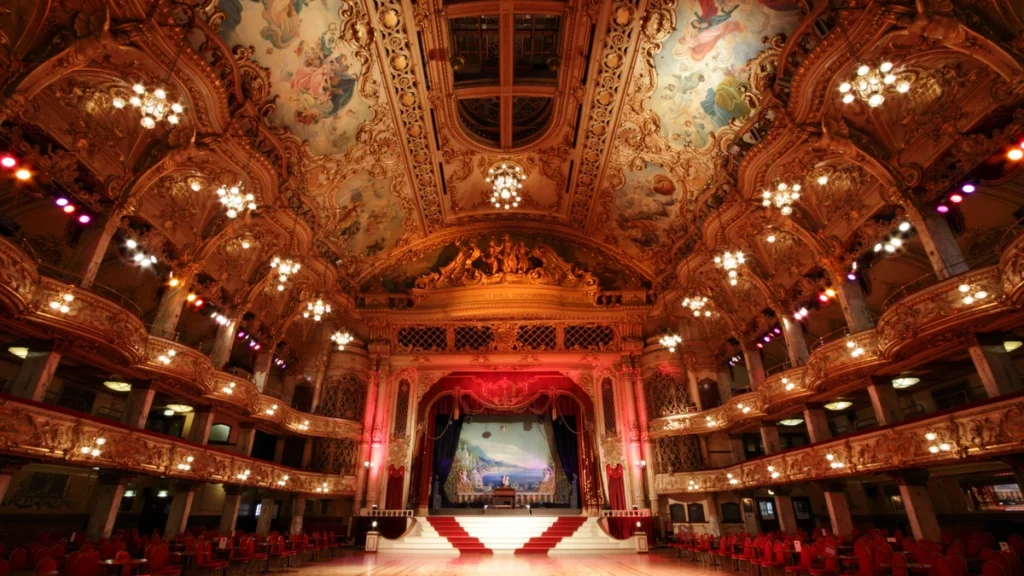
The Blackpool Tower Ballroom.
The Blackpool Tower Ballroom.
The Blackpool Tower’s soul weekender splits its building along a line drawn in the 1970s. Northern Soul and Motown go in the Ballroom. Modern Soul goes up to the Fifth Floor. Collectors’ records go in the Walkway.
To anyone outside the scene that looks like sensible room allocation. It is actually the tidiest possible settlement of an argument that once divided the whole movement.
Twenty Years in the Tower
The venue is marking twenty years since the first Northern Soul weekender it staged, and the billing is unusually specific about what happens where.
Northern Soul and Motown classics in the Ballroom; rare collectors’ soul in the Walkway; Modern Soul on the Fifth Floor. Alongside them sit the Blackpool Tower World Northern Soul Dancing Competition and a Blackpool Mecca 70s Soul Reunion.
That last item is the one that gives the weekend its historical weight, and it points at a building that no longer exists.
What Happened in the Highland Room
The Blackpool Mecca stood on Central Drive, a large entertainment venue that opened in 1965. Its Highland Room operated as a soul venue from 1967 to 1979 and became one of the most important rooms on the scene.
It worked differently from its rivals. Wigan Casino and the Golden Torch ran all-nighters; the Highland Room ran from eight in the evening until two in the morning on Saturdays. That is a normal night out, not an endurance event, and it attracted a slightly different crowd for that reason alone.
Its DJs were Ian Levine and Colin Curtis, and the records they broke there are part of the canon: Tony Clarke’s “Landslide”, Morris Chesnut’s “Too Darn Soulful”, Frankie Beverly & the Butlers’ “If That’s What You Wanted”, and R. Dean Taylor’s “There’s a Ghost in My House”.
“Broke” is the operative verb, and it describes a job that barely exists now. A northern soul DJ was not selecting from a catalogue everyone could reach; he was sourcing American singles nobody in Britain had heard, often bought in bulk and sight unseen, then finding out on a dancefloor which of them worked. A record that took hold at the Highland Room could go from unknown to essential across the whole scene within weeks, on the strength of one man’s judgement in one room.
A Change of Tempo, and a Split
Then the room changed. Later in the 1970s the Highland Room moved towards a more contemporary and less frenetic sound — the Carstairs’ “It Really Hurts Me Girl”, Voices of East Harlem’s “Cashin’ In”, the Charisma Band’s “Ain’t Nothing Like Your Love”.
Because the tempos dropped, the dancing changed with them: a slightly different shuffling style developed at the venue, because a body cannot do the same thing to a slower record.
This was controversial, and it did not stay contained. The dispute produced Modern Soul as a parallel subgenre, which has existed within and alongside mainstream Northern Soul ever since.
It is worth being clear about what was at stake, because from outside it looks trivial. Northern Soul had defined itself by rescuing obscure mid-sixties American 45s; playing new records, however good, broke the founding condition. One side thought the scene was about a sound, the other that it was about a period.
Four Rooms, Four Constituencies
Fifty years on, the Blackpool Tower’s answer is simply to give each faction its own floor.
That is more diplomatic than it appears. A weekender that programmed only the sixties canon would exclude the Modern Soul audience; one that mixed both on a single floor would satisfy nobody, because the dance styles are genuinely incompatible in one room.
The Walkway strand — rare collectors’ gems — serves a third constituency again, the people for whom the point was never the dancing but the records, and whose relationship to the scene runs through ownership and discovery.
Adding a world dancing competition to that is a reminder that this is the rare music culture where the audience’s technique is itself a discipline, judged and competed over. In most scenes the dancing is a response to the music; here it is a practice with its own standards, taught, inherited and now formally adjudicated in the room where it is performed.
The Ballroom is also a peculiar and rather perfect setting for it. Built for Victorian ballroom dancing, with a sprung maple floor and a painted ceiling, it was designed for a completely different body of music and turns out to suit this one exactly — a hard, resilient surface is precisely what northern soul dancing requires.
The Building That Isn’t There Any More
The Mecca reunion happens at the Tower because it has nowhere else to go. The Mecca closed in the 1980s and was demolished in January 2009, to make room for campus buildings for Blackpool and The Fylde College. The college then withdrew after a funding problem, and the site was subsequently earmarked for housing.
So the venue that produced half of this weekend’s programming was knocked down for a building that was never built. It is a fittingly undignified end for a scene whose venues were almost never purpose-built and almost never protected — ballrooms, casinos and cinemas borrowed for a few hours a week, then repurposed or cleared as soon as the lease made more sense to somebody else.
What survives is on record. Kent, Goldmine, Sanctuary, Sony and others have all issued Highland Room compilations, from Mecca Magic in 1990 through The Blackpool Mecca Story and Spirit of the Mecca to Reachin’ For The Best in 2004 and Highland Room – The Golden Era in 2009 — a reissue trail that has done more to preserve the room than any plaque.
Seven compilations across nineteen years, for a club night that ran on Saturday evenings in a single room, is an unusual amount of documentation. It is also the mechanism by which the Highland Room’s argument won: the records that caused the split are permanently in print, and the ones that were meant to displace them never did.
Why the Argument Was Worth Having
Richard Williams, writing at The Blue Moment about the recent documentary, listed the venues he never made it to — “the Torch in Stoke on Trent, Blackpool Mecca or Wigan Casino” — and described the pull the scene exerted on him anyway as something like the Welsh word hiraeth, a longing for a home you may never have known.
That is the emotional register the schism was fought in. People were not arguing about BPM; they were arguing about whether a thing they loved was allowed to change.
Both answers turned out to be right, which is why both rooms are full. The sixties canon has proved durable enough to fill a ballroom in its sixth decade, and the newer strand it fought with has had fifty years of its own records since.
It is the same accommodation the scene keeps reaching — P.P. Arnold headlines the other Blackpool soul festival this year with a set built for an audience that adopted her decades after the fact. Northern Soul has always been better at absorbing than its reputation for purism suggests, and the proof is a Victorian ballroom with three different soul nights running in it at once.
About The Author





More Stories
Kirk Franklin Takes the Record Behind Dey Know to Church
The Line From Port Harcourt to Holy Ghost, Where D.A BIZ Sets a Prayer to Afrobeat
Why Eyes Closed by STARNAMEDSUN Still Matters to the Lineage of Dark R&B