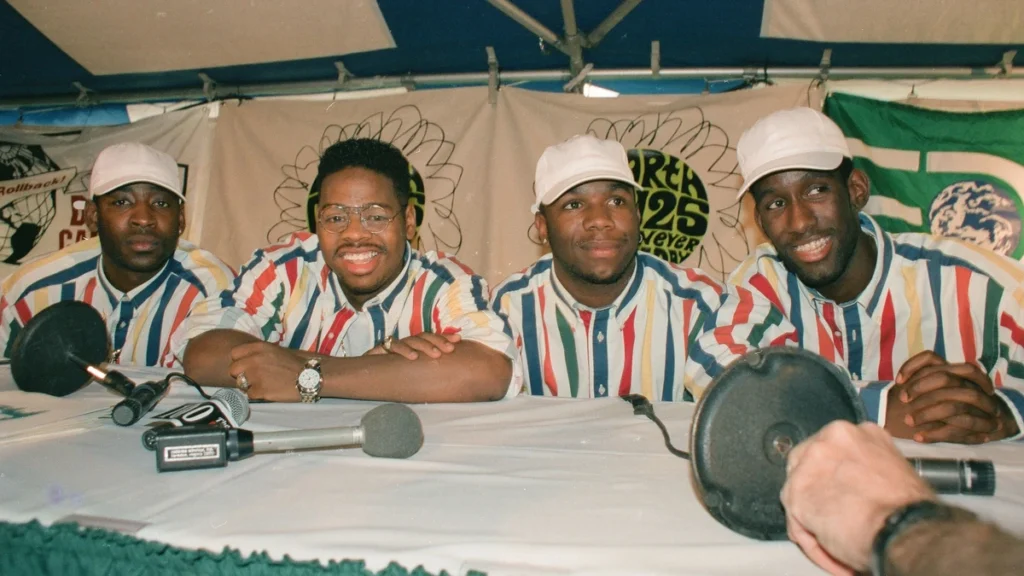
Boyz II Men at an Earth Day event in Washington, D.C., 1995.
Boyz II Men at an Earth Day event in Washington, D.C., 1995.
Boyz II Men have sold 64 million albums, which makes them the best-selling R&B group there has ever been. They have just booked four nights in a Las Vegas ballroom for the spring after next.
The two facts are related. A catalogue that size does not need a new record to keep working; it needs rooms to be performed in.
Four Nights in March
The Las Vegas Sun reported the announcement on Monday: a return to The Chelsea at The Cosmopolitan of Las Vegas for 12, 13, 19 and 20 March 2027, all at eight o’clock.
It will be the fourth consecutive year the group has played the venue, following runs each August in 2024, 2025 and 2026. Four annual engagements at the same room is a working relationship rather than a booking.
Moving the dates from August to March is a small commercial detail worth noticing. A Las Vegas residency’s audience is largely people who came for something else, and shifting a run into a different season is a decision about which visitors you want in the room.
Nathan Morris, Wanya Morris and Shawn Stockman have four Grammys and a run of records — “End of the Road”, “I’ll Make Love to You”, “One Sweet Day” — that are still what most of the audience is buying a ticket to hear.
The Genre They Were Recruited Into
Boyz II Men arrived in the early nineties, at the point where new jack swing had already reorganised R&B around drum programming and swing-beat percussion. They were never the hardest-edged act in that movement, and they were essential to it anyway.
Teddy Riley, who invented the sound, includes them in his own account of it. “I ran with it and everybody joined the movement,” he told Sound on Sound. “Bobby Brown, Kool Moe Dee, Guy, Blackstreet, Boyz II Men, Bel Biv Devoe, New Kids On The Block, N Sync, Backstreet Boys — they made my genre big.”
What the group contributed was the vocal half of the equation. New jack swing rhythms are mechanical by construction, and a four-part harmony group singing over them supplied the human element that stopped the records sounding like exercises.
That balance is the reason the ballads worked. A slow song delivered by four voices in close harmony, with the beat pulled back rather than removed, is what the format eventually became — and it is why the group’s biggest records are the slowest ones.
What Sixty-Four Million Means
The sales figure is worth sitting with, because it belongs to a vanished commercial world. Sixty-four million albums were sold to people who bought physical copies, mostly in a fifteen-year window, at a price nobody pays now.
It also explains the shape of the current career. An act with that much catalogue in circulation has a permanent audience of people who already own the records and will pay to hear them performed, which is a different business from selling new music.
Four Grammys and a run at the top of the Hot 100 gave them the standing; the residency model gives them somewhere to spend it. Las Vegas has become the default answer for exactly this position — a fixed room, a set audience, no touring costs.
The economics are worth spelling out, because they are the reason so many acts of this vintage end up on the Strip. A touring production is rebuilt in a different building every two days, with trucks, crew and a new load-in each time; a residency builds it once and leaves it standing. For a vocal group in particular — three men, a band, and a show that depends on hearing every part clearly — playing the same room repeatedly means the sound is solved on the first night and stays solved.
A Biopic and a Documentary
The Sun describes a “global resurgence” being assembled around the group: a biopic and a documentary both in progress, plus a feature tied to Disneyland’s seventieth anniversary.
Two films at once is an unusual arrangement, and the split makes sense. A biopic sells the story to people who were not there; a documentary sells the footage to people who were. They are aimed at different audiences and do not compete.
The genre has been through this recently. Elaine Constantine’s dramatised Northern Soul and the documentary Northern Soul: Still Burning now supply each other with material, and the drama’s clips end up inside the documentary. A group with a catalogue this well known has an obvious incentive to control both versions.
The Disneyland feature is the least glamorous item and possibly the most instructive. A seventieth-anniversary programme reaches an audience of families who have no particular relationship to nineties R&B, which is precisely the audience a heritage act has to recruit.
On Tour With New Edition
Before any of that, they spent the first months of the year in arenas. Rated R&B reported the thirty-city New Edition Way Tour, powered by the Black Promoters Collective, opening at the Oakland Arena on 28 January and closing at the Toyota Center in Houston on 4 April, with Toni Braxton also on the bill.
Gary Guidry, the collective’s chief executive, framed it as a gathering rather than a package: “You’re seeing artists who’ve shaped the culture come together to celebrate music that continues to stand the test of time.” Its president, Shelby Joyner, called it “the spirit of collaboration, excellence, and respect for pristine artistry”.
The tour takes its name from a street in Boston recently renamed for New Edition. Putting Boyz II Men on that bill closes a loop: New Edition produced both Bobby Brown and Bell Biv DeVoe, the acts at the centre of new jack swing, and Boyz II Men are the vocal group that inherited the audience.
Adding Toni Braxton completes the picture of what these arenas are actually selling. Three bills of material from roughly the same decade, playing to an audience that bought all of it at the time, in rooms that hold twelve to eighteen thousand people. Almost no artist working today can fill one of those buildings on a current record; several artists whose records are thirty years old can fill thirty of them in a row.
Why the Slow Ones Lasted
Almost everything that made these records commercially enormous was in the ballads, and ballads are the hardest thing for a heritage act to keep performing. An uptempo record can be carried by a band and an audience; a slow one is four voices, exposed, with nowhere to hide.
That is the genuine reason a fourth year in the same venue is an achievement rather than a formality. The material demands the singing still be there, and a residency puts it in front of the same room repeatedly enough that any decline would be obvious.
It is the same territory Maxwell described when he explained why he would not release his album while singing in pain — the quiet storm repertoire is unforgiving in a way that up-tempo music is not, because the whole record is the voice.
There is also the small matter of what these songs turned out to be for. “End of the Road” and “I’ll Make Love to You” have been playing at weddings and funerals for thirty years, which is a form of longevity no chart measures and no label plans.
About The Author



More Stories
Kirk Franklin Takes the Record Behind Dey Know to Church
The Line From Port Harcourt to Holy Ghost, Where D.A BIZ Sets a Prayer to Afrobeat
Why Eyes Closed by STARNAMEDSUN Still Matters to the Lineage of Dark R&B