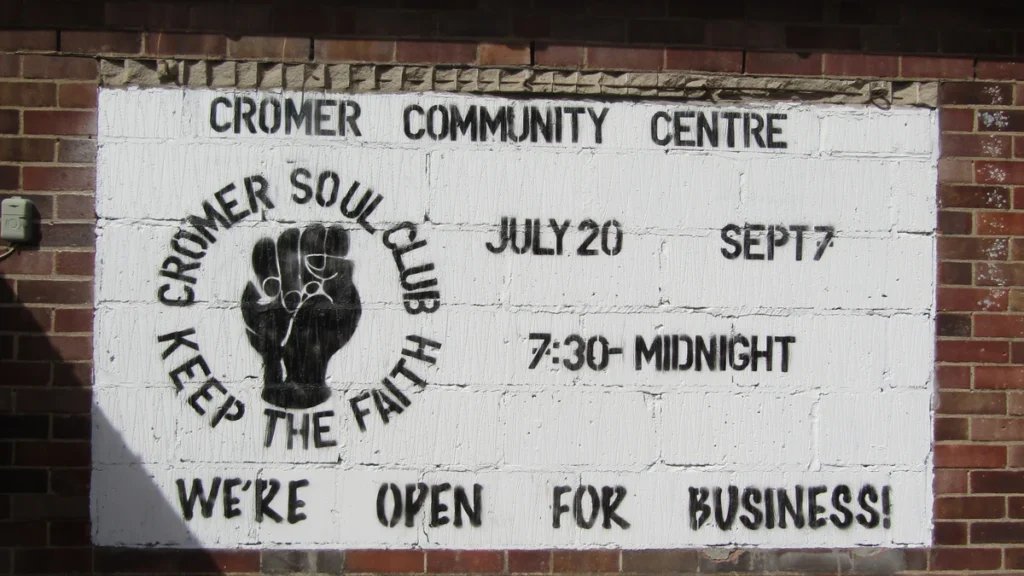
A painted sign for the Cromer Soul Club at Cromer Community Centre, Norfolk.
A painted sign for the Cromer Soul Club at Cromer Community Centre, Norfolk.
Wigan Casino closed in 1981. The band now playing its repertoire around Britain is fronted by a singer who was born more than two decades after that.
Freddy Gillmore is twenty-four. He leads The Signatures, a ten-piece band that All Music Magazine describes as the UK’s most authentic Northern Soul live show, and which played Hangar 34 in Liverpool on 18 July.
A Twenty-Four-Year-Old Out Front
The band’s credentials are not those of a tribute act. They served as house band for the Craig Charles Funk and Soul Show on BBC 6 Music, which is a working session brief rather than a nostalgia booking.
What has changed around them is the room. All Music Magazine reports “a massive national resurgence” for the scene, with “a completely new generation of youth interest” taking over the dancefloors — “trading modern clubbing for the choreography, classic style and timeless vinyl beats of original soul culture”.
Putting a twenty-four-year-old at the microphone is the visible consequence of that. A scene whose members have spent fifty years being told it belonged to their parents has quietly acquired singers who were not alive for any of it.
What a House Band Is For
The Signatures’ real function is easy to miss. Northern soul is a DJ culture built on records — specific pressings, held by specific people — and a live band is in one sense beside the point.
Except that the original singers are still alive, and somebody has to play behind them. The band’s list of collaborators reads like an inventory of who is left: Tommy Hunt, Bobby Wilson, Dean Parrish, Sidney Barnes, Gloria Jones, Eddie Holman.
Their own account of working with Tommy Hunt is the giveaway. A Rock and Roll Hall of Fame inductee as a member of the Flamingos, known on the circuit as “the oldest man in soul”, he worked with them so often that “we saw him as the 12th member of the band”.
That is a different relationship from booking a legend for a nostalgia night. A band that has backed the same singer repeatedly over years knows the arrangements the way a rhythm section does, not the way a covers act does.
Ten pieces is also a specific choice. These records were cut with full sections — horns, strings on the more ambitious sides, a rhythm section playing to a room rather than a click — and reproducing them with four musicians and a keyboard patch does not work. The tempos are unforgiving too: a northern soul floor-filler runs faster than most people remember, and a band has to hold that pace for two hours while dancers who know every break watch them do it.
Two of the Three Before Eight
Every Wigan Casino all-nighter ended with the same three records. The Blue Moment lists them: Tobi Legend’s “Time Will Pass You By”, Jimmy Radcliffe’s “Long After Tonight Is All Over” and Dean Parrish’s “I’m on My Way”. On the Casino’s final night in 1981, Richard Searling played the sequence three times.
The Signatures have performed with two of those three singers. Dean Parrish shared a stage with them several times, and some of the band played on one of his recent recordings.
Tobi Legend is the more remarkable entry. The band performed with her in 2017 in what they describe as her only UK appearance ever — a singer whose record closed thousands of British nights, standing in a British room for the first and only time, forty-odd years late.
That gap is the whole strange shape of this music. The records were made in America for an American market that ignored most of them, and the ritual built around them happened three thousand miles away, largely without the people who sang them ever knowing.
The Motown Alumni on the Roster
A striking proportion of the original artists the band has worked with came through Motown or its orbit.
Sidney Barnes was a staff writer and producer for both Motown and Chess, and did a short UK tour with the band in 2018. Gloria Jones — known on the scene as the Queen of Northern Soul — had a long Motown career before becoming a key member of Marc Bolan’s T. Rex, and now runs her own charity in Sierra Leone.
Others on the list connect outward rather than back. Nolan Porter, born in Los Angeles in 1949, recorded two albums and six singles in the early seventies; his “Keep On Keeping On” reached a wider audience in 1978 when Joy Division lifted its guitar riff for “Interzone”.
Spyder Turner made his name in Detroit and at the Apollo. Jimmy Thomas sang behind Ike and Tina Turner before working with David Essex, Madness and Lloyd Cole and the Commotions. Ken Knox has been in Chairmen of the Board for forty-eight years.
Eddie Holman gets the best description on the page: a falsetto still intact, a metallic gold suit, and a fully ordained Baptist minister whose “musical stylings will take you to church”.
Why the Young Turned Up
All Music Magazine credits the documentary Northern Soul: Still Burning with much of the influx, and the timing supports it — the film reached cinemas in May, the resurgence is being reported through the summer.
The documentary itself pointed at the same thing. It interviewed two young men running northern soul nights in Deptford, and closed on the new wave of dancers rather than on the Casino’s last night, which several of the film’s older contributors evidently found harder to accept than others.
Our own review of that film noted what it leaves out — chiefly the American musicians who made the records. The live band is, in an unplanned way, the correction: it puts those singers on a British stage instead of describing them.
What draws a twenty-year-old to this rather than to a club is worth taking seriously. The scene offers a dress code, a dance vocabulary that must be learned, records you cannot stream, and a room where the point is the floor rather than the bar. Very little contemporary nightlife asks that much of anybody.
Keep the Faith, Cromer Community Centre
The infrastructure holding all of this up is unglamorous. Community centres, a painted sign on a brick wall, a start time of half past seven and a finish at midnight.
That has always been the scene’s actual architecture. Wigan Casino was a former ballroom; the Torch was a converted cinema; the venues now are function rooms and small halls in towns nobody writes about. None of it was ever purpose-built, and none of it ever needed to be — the requirement is a sprung floor, a sound system and somebody willing to unlock the door at midnight.
Dave Godin gave the music its name in a column in Blues & Soul, describing what northern record shops were selling. Everything since has been assembled by people with no institutional backing at all — DJs, collectors, promoters booking halls, and now a ten-piece band with a singer young enough to be their grandchild.
Fifty years on, the records still work on a wooden floor at midnight, and there is a queue of people who were not there the first time waiting to find that out. The sign on the wall in Cromer states the position without any sentiment at all: keep the faith, half past seven till midnight, we’re open for business.
About The Author



More Stories
Kirk Franklin Doubts the Fans Who Asked for Old Kirk
Ian Roland Plays a Twelve-String, and the Line Runs Back to Lead Belly
Giuseppe Cucè 21 Grammi and the Line From the Gospel Hammond to Catania