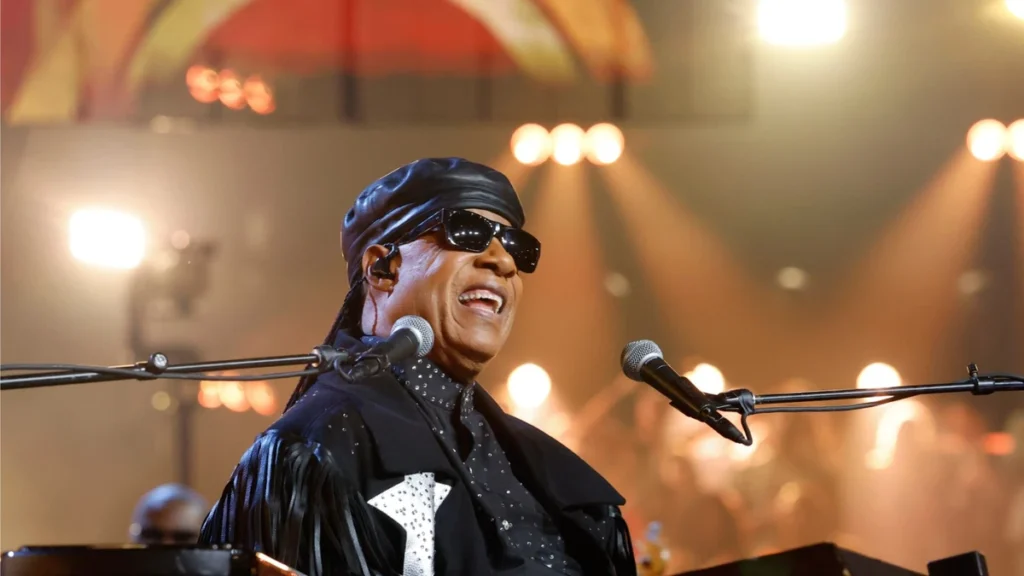
Fifty years ago, on 28 September 1976, Motown released a double album with a bonus EP tucked inside the sleeve: 21 tracks in all, made with well over 100 musicians across its sessions. On 13 October 2026, at Utilita Arena Birmingham, Stevie Wonder begins a world tour built around performing the album, Songs in the Key of Life, in full at every show.
The tour marks the record’s 50th anniversary and runs through the UK, Europe and the United States until 19 December. According to Rolling Stone’s report on the tour, Wonder will play the album in its entirety each night, an ambitious undertaking for a double LP of 17 tracks with a running time of nearly 90 minutes. Rolling Stone noted that it was unclear whether the four songs from the companion EP, A Something’s Extra, would also make the set.
An Album Built on a Decision to Stay
The record almost did not happen. Before making it, Wonder was close to quitting the music industry to dedicate himself to humanitarian work in Africa, Rolling Stone recalls, and changed course after signing a new Motown contract that was both lucrative and gave him complete creative control.
The Library of Congress tells the same story from the other side. In its National Recording Registry essay on the album, written by Bill Hart, the making of Songs in the Key of Life is described as close to two years of total immersion: hopping from studio to studio, working day after day and sometimes around the clock. Hart reads the joy on the record as a reflection of that personal turn, a triumph of hope over despair that runs through the songs themselves.
The ambition shows in the scale of the sessions. The essay counts well over 100 artists and musicians on parts of the album, from George Benson and “Sneaky Pete” Kleinow to Herbie Hancock and Minnie Riperton. One constant was the young keyboard player Greg Phillinganes, whom Wonder is credited with discovering. Phillinganes doubled the keyboards, which Hart suspects gave Wonder more freedom to explore.
The Lineage the Album Carried Forward
Songs in the Key of Life closed what Hart calls a definitive trilogy at the peak of Wonder’s powers, starting with Innervisions and running through Fulfillingness’ First Finale. Funk had already matured into its own language by then, with Sly and the Family Stone and Parliament-Funkadelic working that vein, and African-inspired elements were already part of jazz, rock and pop. What changed with this album, in Hart’s telling, was how completely those elements were transformed into something musically unique, far more than a crossover of styles.
The influence ran outward in every direction. The Registry essay traces it through R&B, hip-hop, jazz and modern pop, and says the album laid the foundation for much of what followed in the work of artists such as Prince and Michael Jackson. That reach is one reason the anniversary feels less like a museum piece than a family gathering.
The numbers kept pace with the reputation. The album reached No. 1 on the Billboard 200, earned Diamond certification from the RIAA and won Album of the Year at the Grammys. It produced two No. 1 singles, “I Wish” and “Sir Duke”, alongside songs that have never left the culture: “Isn’t She Lovely”, “Pastime Paradise”, “Black Man” and “Knocks Me Off My Feet”. Rolling Stone ranks it No. 4 on its list of the 500 Greatest Albums of All Time, and the Library of Congress added it to the National Recording Registry in 2005.
Four Songs From the Original Sessions
The anniversary came with new music from old tape. On 28 September 2026, the album’s 50th birthday, Wonder released a four-track EP of previously unreleased songs from the original sessions, as Consequence reported: “It’s Easier”, “My Life Story of Love”, “I Can See the Sun In Late December” and “I’m Into Livin'”.
Wonder personally curated the set and produced the recordings, which were mixed by the album’s original recording and mixing engineers, John Fischbach and Gary O Adante, credited as Gary Olazabal on the original album. In a statement, Wonder described the songs as part of what he was feeling and discovering during the making of the album, even though they never made the final running order, and said they now become part of the listener’s life too.
For anyone who has lived with the 1976 sequence for decades, that is the real gift of the release. It is a rare chance to hear the edges of a famous session: the ideas that sat beside the finished record without ever displacing it.
Birmingham to Los Angeles: The Full Tour
The Songs in the Key of Life Performances, as the 50th anniversary tour is billed, opens in Birmingham on 13 October. Smooth Radio’s guide to the UK dates notes that an extra London show was added after the first announcement, giving the UK five nights in total. The full schedule is:
- 13 October: Birmingham, Utilita Arena
- 15 October: Paris, Accor Arena
- 18 October: Copenhagen, Royal Arena
- 20 October: Oslo, Unity Arena
- 22 October: Stockholm, 3Arena
- 24 October: Hannover, ZAG-Arena
- 26 October: Cologne, Lanxess Arena
- 28 October: Amsterdam, Ziggo Dome
- 1 November: Dublin, 3Arena
- 3 November: London, The O2
- 5 November: London, The O2
- 8 November: Manchester, Co-op Live
- 11 November: Glasgow, OVO Hydro
- 19 November: New York, Madison Square Garden
- 21 November: Chicago, United Center
- 23 November: Washington, DC, Capital One Arena
- 8 and 9 December: Detroit, Fox Theatre
- 19 December: Los Angeles, Intuit Dome
The two nights at Detroit’s Fox Theatre bring the album home to the city where Motown began, a fitting stop for a record that came out of Wonder’s renewed commitment to the label.
Why Playing It in Full Matters
Albums of this length are rarely played intact on stage, where setlists usually favour the hits. Committing to the full sequence means songs that have lived mostly on record, the long devotional pieces and the quieter turns, get the same stage as “Sir Duke” and “I Wish”.
It also changes how an audience hears the record. A double album asks for patience, and its arc only becomes clear when it is played in order: the celebrations, the grief, the social commentary and the moments of pure joy sitting side by side. Hart’s essay points to that mix of moods as the album’s strength, from the joy in the face of life’s troubles on “Joy Inside My Tears” to the sense of the eternal on “As”.
BlackSounds.News has written before about Wonder’s generosity as a songwriter, including the story of how Stevie Wonder gave away songs he never recorded himself. This tour is the opposite gesture: a songwriter holding up one complete body of work and playing every note of it for a new generation.
From the BlackSounds.News Curator Team: “Songs in the Key of Life is a lineage record. You can hear Motown, jazz, funk and gospel carried into one session, and you can hear everything that came after it reaching back. Playing it in full lets a new audience hear that line from end to end.”
What to Expect From the Shows
The concerts are a rare chance to hear an album that shaped R&B, hip-hop and modern pop played as one continuous piece by the person who made it. With the tour announcement silent on whether the companion EP will be played, and four newly released session songs now in circulation, the early dates in Birmingham and Paris will show how Wonder chooses to frame the record half a century on.
For listeners who cannot make a show, the best preparation is the album itself, played start to finish, followed by the four songs from the 50th anniversary EP. Heard together, they show a session that was overflowing with ideas, and an artist who chose to stay and finish it.
About The Author



More Stories
Why a Pop Chorus Over a Hip-Hop Beat Still Matters on Hold Me Close Now! By Gloria May Byron
Fill My Cup by GRECA: How Neo-Soul Built a Sanctuary for Reflection
The Line From Marvin Gaye to Proceed 2 by Kennard