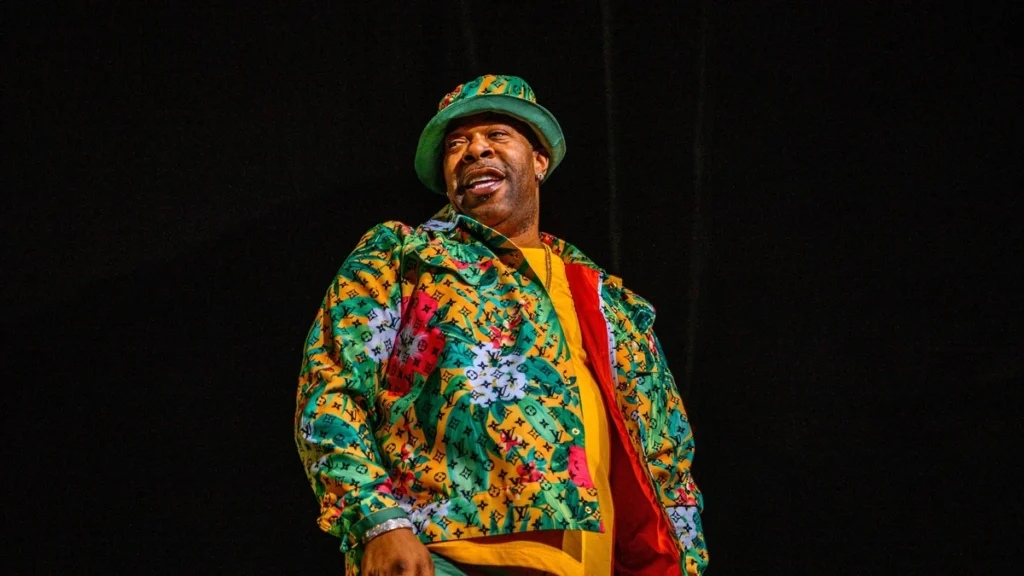
Somewhere in Busta Rhymes’s possession, for twenty years, sat a hard drive most producers would consider a career. More than three hundred beats, made by J Dilla, handed over before Dilla died in 2006 at the age of thirty-two.
Almost none of them had ever been heard. One surfaced on Raekwon’s Only Built 4 Cuban Linx… Pt. II in 2009. The rest stayed private.
Nineteen Tracks From a Twenty-Year Archive
Dillagence II was released on 25 August 2026 through The Conglomerate Entertainment: nineteen tracks, an hour and twenty seconds, credited to Busta Rhymes and J Dilla jointly.
Dilla is the principal producer, with Karriem Riggins, Black Milk and Kev Brown also credited — three producers who have each spent years working in and around the tradition Dilla defined, and who are among the small number of people qualified to finish anything he left unfinished.
A posthumous record built from an archive is a delicate thing. The unavoidable question is whether the dead party would have sanctioned it, and it usually cannot be answered. Here the answer is closer to hand than usual: the beats were given directly to the rapper using them, by the person who made them, while he was alive.
The Relationship Predates the Archive by a Decade
This is not a stranger raiding a vault. J Dilla contributed to six of Busta Rhymes’s first seven studio albums, the sole exception being Extinction Level Event: The Final World Front in 1998.
That is an unusually long partnership by rap’s standards, and it explains the size of the handover. A producer does not pass three hundred instrumentals to someone he has worked with once.
The first result came in November 2007, a year and a half after Dilla’s death: Dillagence, a mixtape hosted by DJ Mick Boogie with Busta Rhymes rapping over Dilla beats, featuring Q-Tip, Phonte, Talib Kweli, Raekwon, M.O.P. and Rah Digga. This record is its sequel, nineteen years later.
The scale of what he left behind is easier to grasp against what he finished. James Dewitt Yancey came out of the mid-1990s Detroit underground with Slum Village, co-founded the Soulquarians, made Champion Sound with Madlib as Jaylib, and produced the Pharcyde’s Labcabincalifornia. Donuts, the record most often named as his masterpiece, was released three days before he died.
A catalogue that dense was assembled in barely a decade, which is part of why three hundred spare instrumentals is a believable figure rather than an exaggeration. He worked faster than the industry around him could release.
The Family Signed Off, and Appears in the Trailer
The approvals matter more than the music press usually allows. The album was cleared by J Dilla’s estate and by his mother, Maureen Yancey — long the guardian of his catalogue and reputation.
She is not a silent signature on a contract, either. When Busta Rhymes announced the release date on 4 August, the teaser he posted was a clip of Yancey listening to one of the tracks.
Nor is her involvement confined to the campaign. The album opens on “Ma Dukes Speak Again”, a minute and twenty-one seconds, and closes on “Ma Dukes & J Dilla Closing Word”. Yancey is literally the first and last voice on the record.
That framing changes what the album claims to be. Bookended by his mother, it presents itself less as a rapper’s project using a producer’s leftovers and more as something handed back to the family that has kept his catalogue since he died.
Using a parent’s reaction as promotional material could read as sentimental, or as the least deniable form of endorsement available. Given how many posthumous rap releases have been contested by the families involved, showing her hearing it is the most direct answer to the objection anyone was going to raise.
Busta Rhymes Changed How He Raps for It
The technical decision inside the record is the one worth noting. Busta Rhymes built his reputation on speed — dense, rapid, syllable-heavy delivery that made him identifiable within a bar. On this album he takes a different approach.
That is the correct instinct. Dilla’s production is defined by a deliberately unquantised swing, drums placed slightly off the grid so the rhythm drags and lurches. A rapper filling every space with speed flattens exactly the quality that makes the beat distinctive.
Slowing down to sit inside that pocket, rather than racing across it, means giving up the trademark. It is the kind of concession a rapper makes for a producer he rates, and in this case for one who is not there to argue about it.
A Guest List Built From the Same Era
The features are extensive and pointedly chosen: D’Angelo, Common, Lil Wayne, Anderson .Paak, Big Sean, Ludacris, Jon Batiste, Talib Kweli, Slum Village’s T3, plus Honey Bxby and La Reezy.
Several of those names carry direct Dilla history. T3 was in Slum Village with him. Common and D’Angelo both worked in the Soulquarians orbit he helped define. Talib Kweli appeared on the original Dillagence. Anderson .Paak and Jon Batiste come at it from the live-instrument side, which suits an archive of beats built on played material rather than presets.
The sequencing leaves room to breathe between them. Alongside the full songs sit short pieces — “How the Boss Will Deliver” at 1:22, “The Story of the Old Man” at 1:21 — that work as connective tissue rather than as tracks, which is a structure closer to a Dilla record than to a modern rap album optimised for skipping.
The longest thing on it is the penultimate track, “What We Got in Common”, six minutes and twenty-one seconds with Common and Jon Batiste. Placing the most expansive piece second-to-last, immediately before Yancey’s closing word, reads as deliberate: the record makes its largest musical statement and then hands the microphone back.
Two singles led the way: “Spazzz” on 5 August, then “Talk Ya Shit” with Lil Wayne on 13 August. A third video, “This Woman” with D’Angelo, followed without being issued as a single.
Why It Took Two Decades
The album was first shown publicly on 19 February 2026, at a listening session where Busta Rhymes announced it under the title Dillagence 2. Details stayed thin — the main thing that leaked was a Lil Wayne feature, captured in a preview video Statik Selektah posted to Instagram.
Why now, rather than in 2010 or 2015, is the question the record does not answer directly. The plainest reading is that an archive that size is not a project so much as a responsibility, and that using it badly would have been worse than not using it at all.
There is also a practical point. The people best placed to work with unfinished Dilla material — Riggins, Black Milk, Kev Brown — have spent the intervening decades becoming exactly that. Our piece on the drum machines that defined decades covers the equipment lineage this sits in.
The album also lands in a fuller stretch of Busta Rhymes’s career than the twenty-year gap implies. It follows Blockbusta in 2023 and Dragon Season… Equinox in 2025, so the archive is being opened by an artist actively working rather than one reaching back for something to release.
Whatever the reason for the wait, roughly three hundred beats remain. Nineteen have now been used.
Dillagence II is out now on The Conglomerate Entertainment.
About The Author

More Stories
Kirk Franklin Doubts the Fans Who Asked for Old Kirk
Ian Roland Plays a Twelve-String, and the Line Runs Back to Lead Belly
Giuseppe Cucè 21 Grammi and the Line From the Gospel Hammond to Catania