
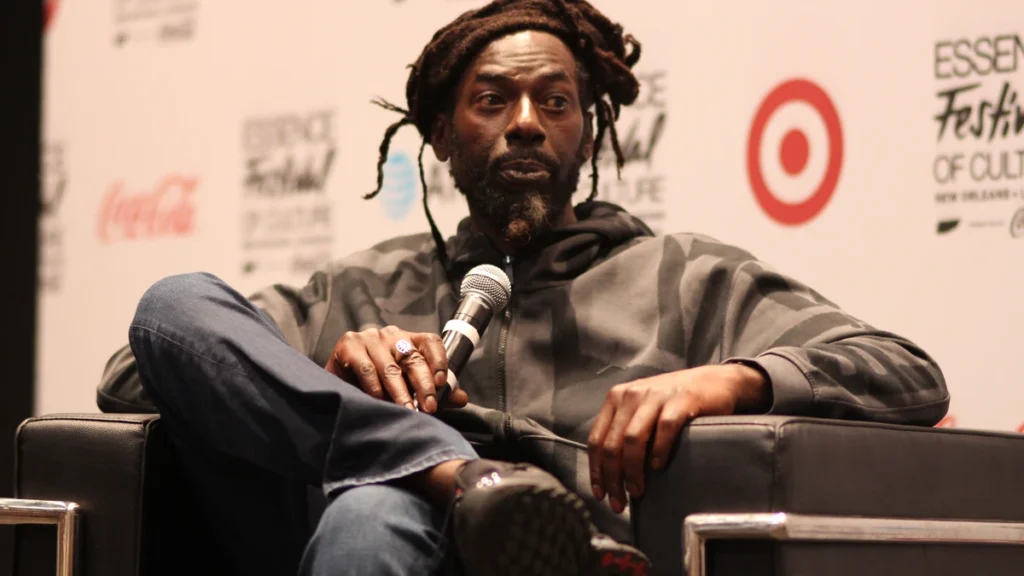
Buju Banton at the Essence Festival of Culture.
Buju Banton at the Essence Festival of Culture.
Younger Jamaican artists are making a hybrid of dancehall and trap, and the industry has settled on a name for it. Buju Banton has no objection to the music. He has a very specific objection to the name.
“You cannot trap dancehall,” he told VIBE. “We avoided all those pitfalls years ago. We were the only music that couldn’t be played on our own radio station in our own country. You understand? They tried to trap us then, and we escaped that.”
The Objection Is to the Word
He is careful to separate the artists from the label attached to them. “The youth them gwan express themselves through the medium and how them feel, but that doesn’t change it from being dancehall,” he said. “It’s dancehall, but it’s their way of doing it.”
What he will not accept is an outside authority renaming it. “We’re not allowing the outside world to dictate to us, ‘but this is trap dancehall.’ No, no, no, no, no.”
His reasoning turns on what the word carries. “The negative connotations certain words bring up… it’s only destruction that follows, you know? I don’t like that. We come to liberate the people.”
Behind that is a piece of history most listeners outside Jamaica have never had to think about: a national music that could not be played on its own country’s radio. Somebody who lived through that has earned a heightened sensitivity to who gets to name things.
Thirteen Albums and a Return
Too Too Bad arrived on 17 July. DancehallMag reported the announcement and the framing he gave it on Instagram: a “Real Dancehall Ting”.
The title points back to Too Bad, his 2006 album, which was itself a hard turn back into dancehall after the roots-reggae direction of ‘Til Shiloh, Inna Heights and Unchained Spirit. Doing the same manoeuvre twice, twenty years apart, is the album’s whole argument in its title.
The record is his sixth for VP Records and, according to News Americas, the first since a new deal returned him to the label after twenty-three years away.
The catalogue behind it is substantial: twelve projects in the top ten of Billboard’s Reggae Albums chart, four of which also reached the Billboard 200, and a Grammy for Before The Dawn at the 2011 ceremony. ‘Til Shiloh has spent 104 weeks on the reggae chart and was certified gold in 2020.
A Riddim From the Sixties
The lead single “Butterflies”, produced by Supa Dups, rides a remake of the Real Rock riddim. Buju corrected the interviewer who called it a classic-ish rhythm.
“Not kind of. It is a classic rhythm. It spans over 40 to 50 years in existence. It was originally done by Sir Coxsone Dodd. It was then again done by… A lot of people play on it. Even Jackie Mittoo played on the first version of it.”
The second single, “X-Rated”, goes the other way — DJ Mac’s new WYFL riddim, one of the dominant rhythms on the Jamaican scene this year. One song on a rhythm from the 1960s and one on a rhythm from this year is not a compromise; it is the thesis.
He lists the others he wants remembered: the MPLA, the Drum Song, Diseases, Shank I Shek. “We had so many riddims that spoke to us as a nation. But somehow through the passage of time, we tend to forget.”
The riddim system itself is the point being defended. A single instrumental carrying dozens of different vocals across decades is a structure no other popular music maintains, and it is what makes a fifty-year-old rhythm a living format rather than a sample.
Where the Music Came From
At a listening session in New York, he gave an account of dancehall’s origins with nothing softened. “No sugarcoat. Bad boys started this. The guys who had experience in the political warfare, gang warfare, police run-ins, whether brutality or whatever, and they sang their experience. They put melodies to their pain and paint a picture that we embrace through the passage of time.”
He also insists on dancehall as a place before it was a genre. “And a movement, which is what it is most importantly, because it depicts the life of those who were the true forbearers.”
His memory of what that place looked like is specific and unrepeatable: “you see 150 tape recorders on the ground, 250 motorbikes over there, 670 extension cords running across the ground, cassettes, and everyone just trying to record the movement.”
His description of what the music does is the best line in the interview. “The painter, he paints on the canvas to capture what the eye beholds. We paint on the rhythm to capture what the spirit and the soul feel.”
He is also that rare performer who works the mixer himself while chatting on the microphone, and he is quick to say he did not invent the habit. “I come from an old school where that was very prevalent. And that’s an integral part of gettin’ the vibes.” He names the engineers whose hands made a sound system worth standing in front of — Danny Dread, Ricky Tropper, Tulluice — “those guys who have the great wrist action fi make the thing sound dynamically dynamic.”
What the sound system supplied beyond music was information: who had died, whose birthday it was, what had happened that week. Buju does not romanticise that part. “The camaraderie and the passing of information was definitely there, but the most integral part was the socializing through the music… We go there to hear the rub-a-dub, dash it down, and turn it up.”
Twenty-Two Cities With Stephen Marley
The album landed in the middle of the Roots and Rhymes tour, a twenty-two-city co-headlining run with Stephen Marley — the first full-scale tour the two have done together. It opened at Marymoor Park in Redmond on 17 June and closed at the Lakewood Amphitheatre in Atlanta on 25 July, taking in Red Rocks, Milwaukee Summerfest and the UBS Arena.
Gramps Morgan of Morgan Heritage joined selected dates. One dollar from every ticket sold goes to the Buju Banton Foundation, which provides skills training and educational support to at-risk boys aged eight to eighteen in Jamaica.
Buju’s own summary of the record is unusually plain for an artist this combative in interview. “A body of work I offer to my fans, friends, and well-wishers with only joy and music.”
Against Monotony
He is dismissive of albums that sit in one place. “I’ve always tried to have versatility on every one of my records because I hate monotony. I don’t want to give you an album with every song sounding like I’m singing about the same topic or with the same melodies or the same musical notes running through. That’s not music. That’s noise.”
He also wanted the tone of the record to move. “Everything is just tailored around blood, guts, and gore, you know? So let us mix it up a bit” — which is why the lead single is, in his words, a girl tune.
There is a neat symmetry with how another genre got its name. Teddy Riley accepted new jack swing gratefully from the journalist who coined it; Buju Banton is refusing the equivalent gift thirty years later, having watched what happens when other people define your music for you.
His position is not preservationist in the museum sense. He is arguing that a form with a fifty-year-old rhythm still in daily use does not need a new category to accommodate whatever gets built on top of it, and that the name it already has is doing fine.
About The Author




More Stories
Andrew Moore and Hooch Trace the Line From Blues to Orbit on “Spaceman”
Kirk Franklin Doubts the Fans Who Asked for Old Kirk
Ian Roland Plays a Twelve-String, and the Line Runs Back to Lead Belly