
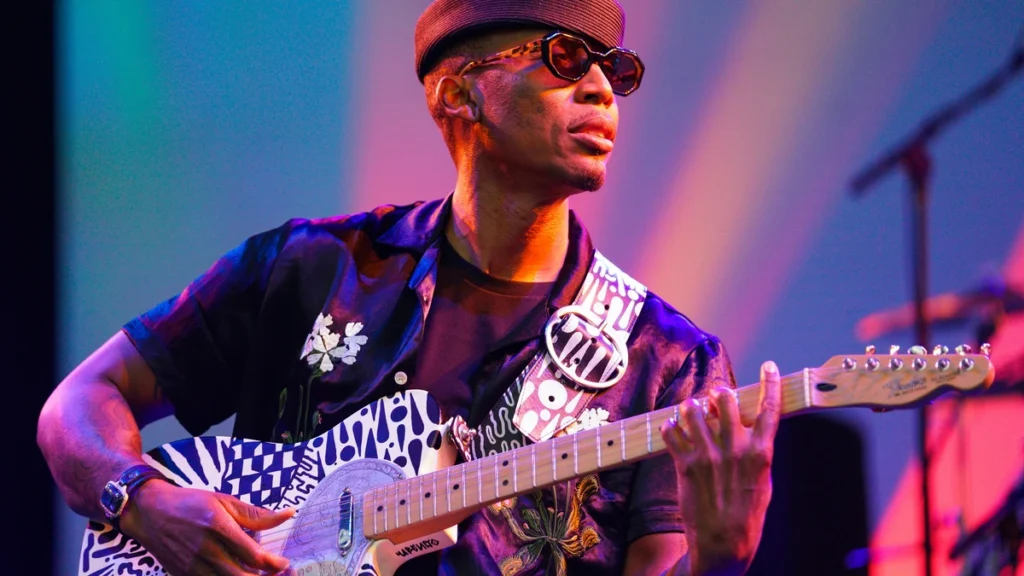
Raphael Saadiq at the Lincoln Center Out of Doors Festival.
Raphael Saadiq at the Lincoln Center Out of Doors Festival.
Asked whether Tony! Toni! Toné! would reunite again, Raphael Saadiq gave an answer that read at the time as ordinary band fatigue. “I don’t think so. I think that was it.”
He was talking about creative differences. Within months the sentence had become literal: his older half-brother and the band’s co-founder, D’Wayne Wiggins, died in Oakland in March 2025 at sixty-four.
The Album That Was Cancelled
The original line-up reunited in 2023 for a short tour, the first time the three of them had played together in close to twenty-five years. Saadiq went into it hoping to make the band’s first new album since 1996.
It did not happen. “We just got overzealous a little bit,” he told Rolling Stone. “The tour was amazing. We had a beautiful time … We’re just at that point where we all don’t feel the same when it comes to working on an album. I’m probably the only one who really wanted to work on records.”
That is a familiar problem in reunions and rarely the one people expect. Playing the old songs to a paying room is a shared pleasure; making a new record is work, and it requires everyone to want the same thing at the same time.
The admission underneath it is unusually honest for a musician discussing a band he loves. Saadiq is not blaming anyone, and he is not pretending the appetite was mutual — he simply says he was the only one who wanted to be in a studio. Most artists in that position announce an album, let it quietly not appear, and never mention it again.
Oakland, 1986
The band was a family operation before it was anything else. Wiggins formed it in 1986 with his younger half-brother, then called Charles Ray Wiggins and later Raphael Saadiq, and their cousin Timothy Christian Riley.
He had started on guitar at eleven, played in his high school band at Castlemont in East Oakland, and toured with the gospel singer Tramaine Hawkins. The three of them worked with Sheena Easton and went out on Prince’s Parade Tour before deciding to start something of their own.
What followed was substantial: fourteen charting R&B singles, five of them number ones, three Top Ten pop singles, a gold album, two platinum and one double platinum, and more than six million albums sold.
It ended in 1997 over finances, miscommunication and creative differences. Wiggins and Riley continued to tour under the name from 1998 to 2018 with Amar Khalil singing lead — which makes the 2023 reunion the first time in a quarter of a century that the actual three had stood on a stage together.
What Wiggins Built Away From the Band
The part of his career least visible from the records is the largest. In 1995 Wiggins founded Grass Roots Entertainment out of his West Oakland studio, the House of Music, and signed Destiny’s Child.
He worked with the group across three albums that have sold more than fifteen million copies between them. Keyshia Cole, H.E.R., Zendaya and Kehlani all came through the same operation.
He won a Grammy as a producer on Alicia Keys’ The Diary of Alicia Keys, released one solo album on Motown in 2000, and spent a stretch as bandleader on D.L. Hughley’s Comedy Central show.
Set against that, “co-founder of Tony! Toni! Toné!” undersells him considerably. A man who signs the best-selling girl group of all time out of a studio in his own neighbourhood is a different kind of figure from a musician who had some hits.
It is also a specifically Oakland story. Wiggins stayed, built the studio in the neighbourhood he was raised in, and developed local talent from there rather than moving to Los Angeles and sending for people. Every artist on that list came through a building in West Oakland, which is a different model of A&R from the one the industry runs on, and a rarer one.
Where the Group Sat in the Era
Tony! Toni! Toné! arrived at the exact moment new jack swing was reorganising R&B, and their position in it was oblique. They played live instruments in a genre being rebuilt around drum machines, and they were an Oakland band in a scene centred on New York and Detroit.
The scene has kept claiming them regardless. YouKnowIGotSoul, surveying the genre this year, lists the group among its landmarks and notes plainly that the future is unclear after Wiggins’ death.
That same survey reports Teddy Riley launching a new lineup of Guy, and a rumoured package tour pairing him with Tony! Toni! Toné! — a booking that can no longer happen as anyone imagined it. Riley’s own list of who built the movement is generous and long, and it is being shortened by attrition rather than argument.
Beyoncé, Prince and a Lost Session File
Saadiq’s own work has continued at a level most of his contemporaries never reached. He produced on Beyoncé’s Renaissance and Cowboy Carter; “Texas Hold ‘Em” dates back to the Renaissance sessions.
“Bodyguard” began as a possible Saadiq solo track. “That little bass line, it feels like Fleetwood Mac,” he said. “Because I love those eras of music.” Beyoncé heard it while he was playing her things from his Dropbox: “‘Bodyguard’ came up for a second — like the intro — and I went to the next one, and she was like ‘Go back, go back!’ … She took what I did and completed it.”
His best story is about Prince, who loved the title track of his 2011 album Stone Rollin’. Playing it at a festival, Saadiq heard the crowd erupt. “So I’m like, I must be really killing it. But then I look behind me, like maybe it’s 10 seconds later and seeing Prince behind me dancing.”
Not everything survives. Solange’s “Crane in the Sky” was nearly lost because Saadiq mislaid the session files; she ended up recording her vocals over an already-mixed instrumental pulled off a CD he had given to a friend. One of the most admired R&B records of its decade exists because somebody happened to still have the disc.
Piano Lessons at This Stage
What he says about his own practice is the least expected thing in the interview. An accomplished bassist, guitarist and drummer, he started taking piano lessons after the pandemic.
“Just really being a student and studying music,” he said. “Trying to sight read, learning theory, just basic stuff. Then when I do start writing, I have an arsenal.”
He also wants to build an eleven-piece band in the Earth, Wind & Fire mould, and is clear-eyed about the obstacle: “I know economically it’s not even doable, but I think I could make it work.” He has one name locked in already — the guitarist Isaiah Sharkey, another D’Angelo collaborator.
There is a line in the same conversation that reads differently now. Talking about Stone Rollin’, Saadiq said he had “sort of missed the era that I should have been in”, that he felt he should have been born in the thirties and playing with the musicians of the sixties. The band he actually had was three people from Oakland, two of them family, and it is not coming back.
About The Author

More Stories
Kirk Franklin Doubts the Fans Who Asked for Old Kirk
Ian Roland Plays a Twelve-String, and the Line Runs Back to Lead Belly
Giuseppe Cucè 21 Grammi and the Line From the Gospel Hammond to Catania