
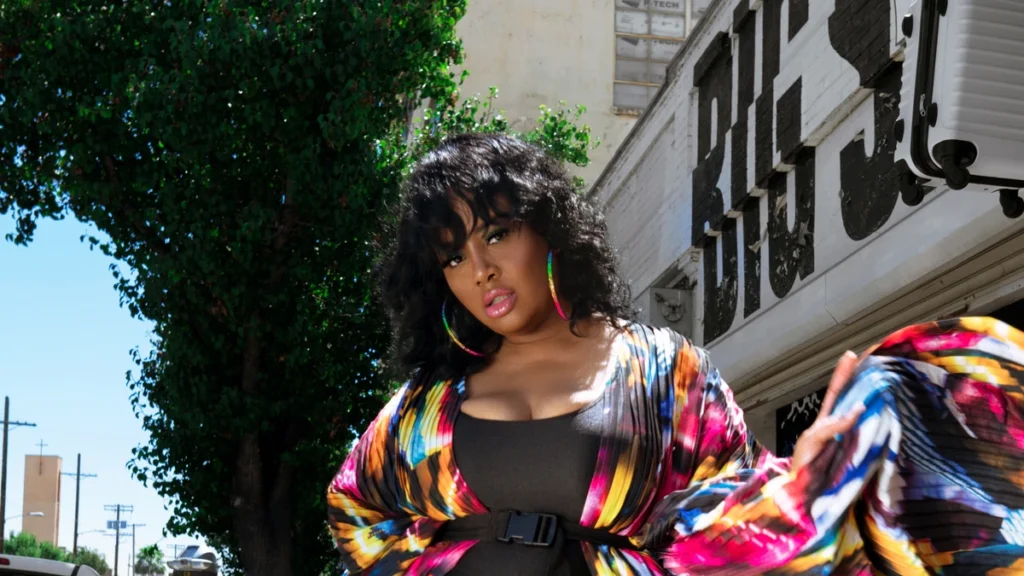
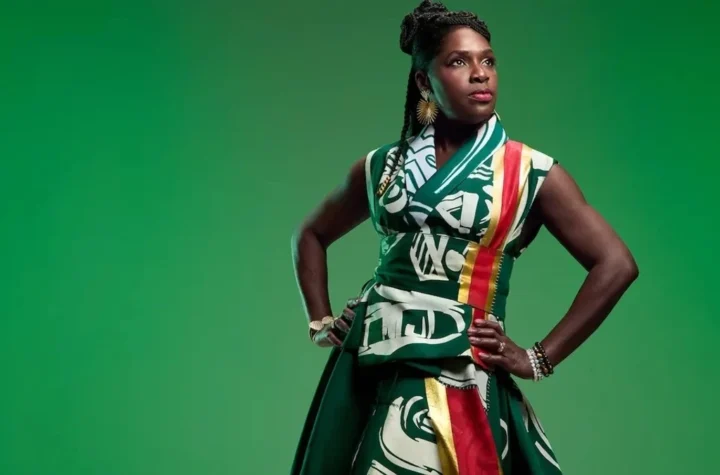
Lalah Hathaway photographed in Los Angeles.
Lalah Hathaway photographed in Los Angeles.
Vantablack is a manufactured material that absorbs 99.965 per cent of the visible light that hits it. Objects coated in it stop reading as objects; the eye sees a hole.
Lalah Hathaway named an album after it, and was explicit about why. The record is, in her words, “a deeply personal examination of my relationship with my Blackness, my place in this country, and how embracing the different facets of my identity has allowed me to feel the most authentic version of myself.”
A Pigment, and an Argument
Albumism opens its review with the research the title is answering — the documented bias that associates darker skin with malice or negativity, sometimes called the “Black is Bad” effect.
The title track states the case directly. “Trying to make the skin I’m in a sin,” Hathaway sings over a soulful guitar-pop arrangement. “Take it all back and start again / Melanin rising, don’t be mad / I want everything VANTABLACK.”
Taking a laboratory material as a metaphor is a cooler move than a protest song. Vantablack is not a shade of paint; it is a structure of carbon tubes engineered to trap light. Naming a record about Blackness after the darkest substance humans have managed to make is a claim about depth rather than about colour.
Her Own Label, Eight Albums In
It is her eighth studio album, released through her own Hathaway Entertainment in association with SRG/ILS Group, and it came seven years after the previous one.
Albumism describes the result as “an odyssey of urban alternative, dance, and progressive jazz affirming life, love, and the embodiment of Hathaway’s full spectrum of being” — which is a lot of ground for one record, and the reason the production is unusually concentrated.
Most of the board work falls to Phil Beaudreau, who has worked with Justin Bieber and Ledisi, and Juan Ariza, a relative newcomer with Dua Lipa credits. Hathaway herself produces on nearly every track.
The album was nominated for Best R&B Album at the Grammys, adding to a career that already holds five wins.
Four MCs and a Saxophonist
The guest list is weighted towards rappers, which is not where a singer of her lineage is expected to look. Rapsody and Common set what Albumism calls a “jazzy-poetic tone” on “Black”. MC Lyte appears on “Mood for You”. Phonte of the Foreign Exchange trades wordplay with her on “You Don’t Know”.
She has earned that room. Hathaway sang on Kendrick Lamar’s To Pimp a Butterfly and appeared on every instalment of Robert Glasper’s Black Radio series through to the third — a decade of work at the exact junction of jazz, hip-hop and soul.
The other end of the record is more traditional. “Lower” rebuilds an earlier track into an avant-garde jazz coda with the saxophonist Gerald Albright, and Willow Smith appears on “Tunnels”.
AllMusic’s Andy Kellman placed the album in a family line, writing that she took her father and Roberta Flack’s “Be Real Black for Me” to heart “and then some”, and that the record is closer in sound to her earlier work than the sharp turn she took on the preceding album.
Kellman also anticipated who would object. Purists who disliked the left turn of Honestly in 2017, he noted, might approach a follow-up carrying four guest MCs and another explicit tag with some hesitation — and would find, on listening, that the stylistic labels needed for these songs all end in the word soul, with modern, throwback, hip-hop, folk and pop as the modifiers in front of it.
The Grown, Sexy Half
The record is not solely a thesis. Albumism notes that Hathaway “knows that her audience responds to grown, sexy sentiments” and aims squarely at them on the opening “So in Love”.
“Mood for You”, produced by Warryn Campbell and Eric Dawkins, is the one the review singles out for sensuality — a wavy groove with an eroticism it compares to Aaliyah’s “Rock the Boat”.
That is the quiet storm half of this record doing its work. Hathaway’s contralto is a late-night instrument, unusually low for a soul singer, and the buzz single “The Energy” is built to sit inside it — an enveloping, bassy refrain with nowhere to hide.
Elsewhere the mood breaks entirely. “#BITMFW” comes with expletives and cascading 808s, “I Am” is nu-disco, and “Higher” is a pseudo-gospel rave that likens a discordant life to dancing on the one and the three instead of the two and the four.
The album’s better half, by Albumism’s reckoning, is the quieter underside. “Returning” works through aquatic metaphors towards healing; “The Machine”, an acoustic track first teased as far back as December 2021, has her weighing up her own existence; “Clearly” closes that thread as an electro-soul climax.
There is a seed for all of this in the back catalogue. “Mirror”, tucked away on Lalah Hathaway Live in 2015, asked the listener to love themselves and stop hiding; the review’s argument is that the plea in that song is what the whole of VANTABLACK grew into.
Still on the Road With It
The album is not new, and she is still touring it — which is the more interesting fact about it. The VANTABLACK dates have continued long past the window a record usually gets.
Jazz 91.9 WCLK announced the next one this week: An Evening of Soul with Robert Glasper at the Mable House Barnes Amphitheatre in Mableton, Georgia, on 26 September, doors at six.
The station’s framing of the pairing is accurate about what each brings. Hathaway is “celebrated for her extraordinary vocals and timeless music”; Glasper “continues to push the boundaries between jazz, R&B, hip-hop and soul”.
Putting the two of them on one bill is not a novelty booking. They have made records together for more than a decade, and an audience arriving for either gets a working partnership rather than a guest spot.
An amphitheatre in a Georgia suburb is also the right size for what this music does. Hathaway’s records reward being heard rather than shouted over, and a seated outdoor room of a few thousand people is the largest space in which a contralto and a piano can still register as two instruments rather than a wall.
What the Contralto Is For
Hathaway’s technical reputation rests on things that do not photograph well: an unusually low range for a soul singer, and a scatting facility she deploys constantly even though, as Albumism puts it, this is “far from a jazz record”.
Those are jazz musicians’ skills applied to soul records, which is why she has spent her career being borrowed by everyone from Lamar to Glasper. It is also why an album this stylistically scattered holds together — the voice is the argument, and the arrangements move around it.
The independence matters too. Releasing through her own company means an album this uncategorisable did not have to survive a marketing meeting, the same arrangement Eric Benét used to make a record with only women on it. Neither album is what a major label would have commissioned.
Albumism ends on the point worth keeping: Hathaway excels at an effect that blooms over time, which is an awkward strength in a market that decides within thirty seconds of a clip. A record still being toured this long after release is what that strength looks like when it is given room.
About The Author

More Stories
Kirk Franklin Doubts the Fans Who Asked for Old Kirk
Ian Roland Plays a Twelve-String, and the Line Runs Back to Lead Belly
Giuseppe Cucè 21 Grammi and the Line From the Gospel Hammond to Catania